
On 1st January 2026, the UAE made history by officially legalising industrial hemp, and the entire country is still trying to figure out what that actually means.
Residents are confused. Businesses are unsure. Expats are worried. Can you now buy hemp products freely? Can you carry CBD oil through Dubai airport? What happens if you get it wrong? The truth is, most people living in the UAE do not have clear answers to these questions. And with administrative fines starting at AED 10,000, and criminal penalties starting at AED 100,000 plus potential imprisonment, getting it wrong is simply not an option.
That is exactly why we wrote this guide. By the time you finish reading, you will have the clearest possible picture of what is legal, what remains
prohibited, and what the current state of UAE hemp law means for you as a resident or business owner in 2026. Where the law is clear, we will tell you clearly. Where details are still being developed through the hemp executive regulations UAE and emirate-level rules, we will tell you that too. In a regulatory landscape this consequential, honest clarity matters more than false precision. This guide has been researched and written by the team at ITSHEMP.AE, UAE’s largest hemp and cannabis discovery and education platform. Our mission is to make complex hemp and cannabis information simple, accurate, and accessible for everyone living in or visiting the UAE.
Outline
- Chapter 1: What is Hemp?
- Chapter 2: History of Hemp Laws in the UAE
- Chapter 3: What Does the 2026 UAE Hemp Law Actually Say?
- Chapter 4: What is Legal in the UAE?
- Chapter 5: What is Still Illegal in the UAE?
- Chapter 6: What This Means for UAE Residents
- Chapter 7: What This Means for Businesses
- Chapter 8: Penalties, What Happens if You Get It Wrong?
- Chapter 9: UAE Hemp Laws vs The Rest of the World
- Chapter 10: Frequently Asked Questions
Chapter 1: What is Hemp?
Across the UAE, one plant is suddenly everywhere, in conversations, in headlines, and increasingly in products on shelves. From hemp seeds, oils, and protein powders to skincare, clothing, and construction materials, people across the Emirates are beginning to discover what the rest of the world has known for centuries. But before we dive into UAE laws, regulations, and what this plant means for your daily life, we need to answer the most fundamental question of all.
What exactly is hemp?
1a. Understanding Hemp, The Basics
Hemp is a strain of the Cannabis Sativa plant species. It is one of the oldest cultivated plants in human history, used for food, medicine, fabric, and construction for more than 10,000 years. And yet, today, it remains one of the most misunderstood plants on earth.
The confusion almost always comes from one place: marijuana.
Hemp and marijuana are both strains of Cannabis Sativa. They share the same plant family, the same general appearance, and some of the same chemical compounds. This is where the similarity ends.
The two are distinguished on three fundamental grounds: their chemical composition, their intended use, and their cultivation practices. Understanding these three differences is the foundation of understanding everything that follows in this guide, including what the UAE’s landmark 2026 hemp law actually means.
1b. The Chemical Makeup of Hemp
This is where the real story of hemp begins, and where most of the confusion ends.
The cannabis plant produces over 100 unique chemical compounds called cannabinoids. Of these, two are most significant: THC and CBD.
THC, Tetrahydrocannabinol
THC is the compound responsible for the psychoactive “high” associated with marijuana. It is what makes marijuana a recreational drug. It is what causes euphoria, altered perception, and intoxication. Marijuana is specifically cultivated to produce high concentrations of THC, typically between 10% and 30%.
Hemp contains THC, too, but in an amount so small it is practically irrelevant. Hemp contains 0.3% THC or less. To put that in perspective, that is up to 100 times less THC than marijuana. Hemp contains such negligible amounts of THC that, under normal consumption, it cannot produce any meaningful psychoactive effect.
This single number, 0.3%, is the legal and scientific line that separates hemp from marijuana in the UAE, the United States, the European Union, and most hemp-progressive jurisdictions around the world.
CBD, Cannabidiol
On the other side of the equation is CBD, cannabidiol. Hemp is the richest natural source of CBD in the cannabis plant family. CBD makes up approximately 40% of the hemp plant’s extract. Unlike THC, CBD is entirely non-psychoactive. It does not produce a high. Instead, it interacts with the body’s endocannabinoid system in ways that researchers are increasingly linking to benefits for anxiety, inflammation, sleep, and neurological conditions.
It is important to note, however, that while CBD is legal in many countries as a consumer wellness product, it remains strictly regulated in the UAE. We cover this in detail in Chapter 4.
Other Compounds
Beyond THC and CBD, hemp contains a rich array of other cannabinoids, terpenes, and flavonoids that contribute to its overall properties. The seeds of the hemp plant, which contain no cannabinoids at all, carry an exceptional nutritional profile of their own, including approximately 25% protein, 30% carbohydrates, and 15% insoluble fibre, along with potassium, phosphorus, magnesium, calcium, iron, and zinc, and vitamins B1, B2, B3, B6, C, and E. Hemp seeds also contain essential fatty acids in a near-optimal 3:1 ratio of omega-3 to omega-6.
1c. What Does Hemp Look Like?
Hemp is a stout, aromatic, erect annual herb. In the right conditions, it can grow up to 5 metres, approximately 16 feet, tall. Its stalks are slender and cane-like, hollow except at the tip and base. Its leaves are palmate in shape, spreading outward like an open hand, and its flowers are small and greenish-yellow.
The plant is dioecious by nature, meaning male and female flowers grow on separate plants. Female plants produce elongated, spike-like seed clusters. Male plants produce multi-branched pollen clusters.
The physical appearance of hemp is where much of the public misconception originates. To an untrained eye, hemp and marijuana can look remarkably similar. But to a botanist, a farmer, or a regulatory official, the differences in their growth patterns, leaf structure, and cultivation environment are immediately visible.
Hemp grown for fibre, for example, is cultivated in dense plantings to encourage tall, straight stalks with minimal branching. Hemp grown for seed is cultivated with more spacing to allow branching and seed development. Neither looks anything like the carefully manicured, heavily branching marijuana plant grown for maximum THC yield.
1d. How is Hemp Cultivated?
The cultivation of hemp varies significantly depending on its intended use. This is one of the clearest ways hemp differs from marijuana, which is cultivated almost exclusively to maximise THC content in its flowering tops.
Hemp for Fibre
When grown for fibre, hemp is planted in dense arrangements, typically 100 to 300 plants per square metre. This close spacing encourages the plants to grow tall and straight with minimal branching. These plants reach harvest heights of 10 to 15 feet and are harvested using conventional hay equipment. After cutting, they undergo a process called retting, where the stalks are left in the field to allow natural moisture and microorganisms to loosen the fibre bundles from the woody core.
The fibre from hemp stalks comes in two forms. The outer bast fibre, tough and long, is used for textiles, paper, composites, and insulation. The inner hurd fibre, shorter and woody, is used for animal bedding, construction materials like hempcrete, and oil absorbents.
Hemp for Seeds
When grown for seeds or grain, hemp is also planted densely but harvested at heights of 6 to 9 feet. The timing of harvest is critical; seeds must be collected in a short window to prevent scatter loss. After harvest, the seeds are dehulled and pressed for oil, or processed into food products such as hemp hearts, hemp protein powder, and hemp milk.
Hemp for Flower
When grown for its flower, the primary source of CBD and other cannabinoids, hemp is given considerably more space. Plants are grown 3 to 5 feet apart, allowing for wide branching and extensive flowering. These plants reach heights of 4 to 8 feet and are harvested by hand, a labour-intensive process that requires careful drying down to 10% moisture. Each plant can yield approximately one pound of dried flower material.
General Growing Conditions
Hemp is a remarkably adaptable crop. It grows in temperate climates with well-drained, fertile soil and requires an average monthly rainfall of at least 65mm throughout the growing season. It is naturally resistant to most pests, requires minimal pesticides, and actively improves soil health, absorbing heavy metal contaminants and suppressing weed growth through its rapid canopy development.
The crop reaches full maturity in approximately 3 to 4 months, making it one of the fastest-growing natural fibre sources on earth.
1e. The Many Uses of Hemp
Hemp is, without question, one of the most versatile plants that has ever existed. Every single part of the plant, its seeds, its stalks, its fibre, and its flowers, can be used to create something of value. It has been described, accurately, as the plant that can clothe you, feed you, house you, heal you, and fuel you.
Here is a comprehensive look at what hemp can do.
Food and Nutrition
Hemp seeds are a genuine superfood. They are one of the very few plant-based foods that contain all nine essential amino acids, making them a complete protein source comparable to meat, dairy, and eggs. They are rich in omega-3 and omega-6 fatty acids in a near-optimal 3:1 ratio, a balance that most modern diets fail to achieve. They contain magnesium, iron, zinc, phosphorus, and vitamins B and E in significant quantities.
Hemp seeds can be consumed raw, sprinkled onto salads and cereals, blended into smoothies, or pressed into cooking oil. Hemp hearts, dehulled hemp seeds, have a mild, nutty flavour and are one of the most convenient ways to add complete plant protein to any diet. Hemp protein powder is a 100% plant-based, gluten-free protein supplement that is rapidly gaining popularity among athletes, vegans, and health-conscious consumers worldwide.
Hemp milk, made by blending hemp seeds with water, is a rich, creamy dairy-free alternative. Hemp seed oil is increasingly recognised as a superior cooking oil and dietary supplement, offering a healthful fatty acid profile that most vegetable oils cannot match.
Wellness and Skincare
Hemp seed oil is extraordinarily rich in essential fatty acids, amino acids, and vitamin E, a combination that makes it one of the most effective natural skincare ingredients available. It is used extensively in facial oils, moisturisers, lip balms, body creams, shampoos, and hair treatments.
Its anti-inflammatory and antioxidant properties help soothe irritated skin, reduce redness, and maintain the skin’s natural moisture barrier. Unlike many other oils, hemp seed oil is non-comedogenic, meaning it does not clog pores, making it suitable for virtually all skin types, including acne-prone and sensitive skin.
In the UAE, hemp seed oil cosmetics have been legally available since 2019, so when people ask, “Is Hemp Legal in UAE Cosmetics?”, the answer actually started taking shape seven years before broader legalisation.
Fashion and Textiles
Hemp fibre is one of the strongest natural fibres on earth, eight times stronger than cotton and four times more durable. Hemp fabric is breathable, antibacterial, resistant to mould and mildew, and softens with every wash. It can be woven into everything from canvas and rope to fine linen and luxury garments.
The environmental case for hemp textiles is compelling. Hemp grows without pesticides, uses a fraction of the water required by cotton, and yields four times more fibre per acre than other crops. As sustainability becomes a priority in the global fashion industry, hemp is increasingly being adopted by clothing brands worldwide.
Construction and Industry
Hemp stalks produce hempcrete, a bio-composite building material made by combining the woody inner core of the hemp stalk with lime and water. Hempcrete is lightweight, carbon-negative, thermally insulating, and non-toxic. It is used as an infill material in wall construction and is attracting growing attention from architects and developers committed to sustainable building.
Beyond hempcrete, hemp fibre is used in paper production, where one acre of hemp produces the equivalent paper yield of ten acres of trees. Hemp is used in bioplastics, insulation boards, animal bedding, automotive composites, and biodegradable packaging.
Medical Applications
Certain compounds extracted from hemp, primarily CBD, have demonstrated significant therapeutic potential in clinical research. CBD-based pharmaceutical products have been approved in several countries for specific medical conditions, most notably treatment-resistant epilepsy. Research continues into CBD’s potential applications for anxiety, chronic pain, neurological conditions, and inflammatory disorders.
Under the UAE’s new 2026 hemp law, hemp compounds are now permitted as ingredients in licensed medical products for the first time in the country’s history, opening a new and significant chapter in the country’s healthcare landscape.
1f. Hemp, A Truly Ancient Plant
To understand hemp fully, it helps to appreciate just how long human civilisations have relied on it.
Hemp is believed to be among the very first crops ever cultivated by human beings. The earliest evidence of hemp use dates back to 8,000 BC in Taiwan, where hemp cords were woven into pottery. Hemp textiles and hemp seeds used as food have been found in ancient Chinese archaeological sites dating to 4,000 BC.
Hemp paper, invented in China around 200 BC, made possible the earliest mass communication and record-keeping in human history. Hemp rope was the backbone of maritime trade for centuries. Hemp clothed entire populations across Europe and Asia for millennia.
The modern misconception that equates hemp with marijuana is, historically speaking, an extraordinarily recent development, one that emerged largely from industrial and political interests in the 20th century, not from any genuine understanding of the plant itself.
Today, as the UAE and many other countries around the world are rediscovering hemp’s extraordinary versatility and value, we are not witnessing the dawn of something new. We are witnessing the revival of something ancient.
Chapter 2: A History of Hemp Laws in the UAE
To truly understand where the UAE stands today on hemp, and why the 2026 legalisation matters so profoundly, you need to understand where the country has come from.
This is not a story that begins in 2026. It is a story that has been quietly building for decades, shaped by global politics, economic ambition, and a growing recognition that one of the world’s most versatile plants deserves a legal framework of its own.
2a. The World Before 2026, Everything Was Prohibited
For most of the UAE’s modern history, hemp did not exist as a separate legal category. There was no distinction between industrial hemp and recreational marijuana. There was no 0.3% THC threshold. There was no licensed pathway for hemp cultivation, hemp manufacturing, or hemp products of any kind.
Under Federal Decree-Law No. 30 of 2021 on Combating Narcotics and Psychotropic Substances, the legal framework that governed the UAE before the new hemp law, cannabis in essentially all its forms was treated as a controlled narcotic substance. Full stop. No exceptions for low-THC varieties. No carve-out for hemp seeds or hemp fibre. No recognition of the fundamental chemical difference between a hemp plant and a marijuana plant.
The practical consequences of this legal reality were severe, and they affected far more people than most UAE residents realised.
A professional returning from a business trip to Canada with a CBD supplement purchased at a licensed pharmacy faced criminal risk at UAE customs. A tourist arriving from the Netherlands with hemp-infused chocolate in their luggage could be detained. An expat who had been using CBD oil for anxiety management, legally, in their home country, faced the very real possibility of arrest, prosecution, and deportation upon returning to the UAE.
These were not hypothetical scenarios. They happened. Regularly. And they continued happening well into the 2020s, long after much of the world had begun to distinguish between industrial hemp and recreational cannabis.
The UAE’s enforcement culture around narcotics is, by design and by reputation, among the strictest in the world. Unlike many Western jurisdictions, where prosecutorial discretion might result in minor charges being dropped, the UAE system historically left very little room for such outcomes. Ignorance of the law was not a defence. The quantity involved was often irrelevant. The intent behind possession was rarely considered.
For the UAE’s expatriate population, which makes up approximately 88% of the country’s residents, this enforcement reality carried an additional layer of consequence. A narcotics conviction, even for a minor offence, typically resulted in mandatory deportation after serving the sentence. For people who had built careers, families, and lives in the UAE, this was not an abstract risk. It was a life-altering one.
2b 2019, The First Crack in the Wall
The first meaningful signal that the UAE’s position on hemp might evolve came not with fanfare or legislation, but with a quiet administrative clarification from Dubai Municipality in January 2019.
Dubai Municipality confirmed that hemp seed oil, derived purely from cold-pressing hemp seeds, containing no THC and no CBD, was permitted for use in cosmetic products. Specifically, products such as serums, lip balms, facial oils, and similar skincare items that list pure hemp seed oil as an ingredient could be legally sold in the UAE.
This was a narrow acknowledgement. Hemp seed oil, processed in the same way as olive oil or coconut oil, carries no narcotic properties whatsoever. The seeds of the hemp plant contain no cannabinoids, no THC, no CBD, nothing psychoactive. They are, in every meaningful sense, simply a nutritious seed. The Municipality’s clarification reflected this scientific reality.
But it was significant for reasons beyond its narrow scope. It was the first time a UAE government body had formally acknowledged that a hemp-derived product could exist in a legal category separate from narcotics. It was the first crack in a wall that had, until that point, been completely solid.
The permission did not extend to CBD oil. It did not extend to hemp supplements, hemp food products, or any other hemp-derived compound. The door had opened, but only the smallest fraction.
2c. The Global Context: Why the World Was Moving On
To understand why the UAE eventually made the decision it made in 2025, it is important to understand what was happening in the rest of the world during this period.
The global industrial hemp market had been growing steadily for years. The United States legalised industrial hemp nationwide under the 2018 Farm Bill, removing it from the Controlled Substances Act and creating a regulated framework for hemp cultivation, processing, and sale. The European Union had maintained a legal framework for low-THC hemp cultivation for decades, with rules continuing to evolve in favour of the industry. Canada, Australia, Switzerland, and many Asian economies had all established regulated hemp sectors of their own.
The global industrial hemp market was no longer a niche agricultural curiosity. It was becoming a significant economic sector, with applications in construction, textiles, pharmaceuticals, food, cosmetics, and sustainable manufacturing. Analysts were projecting the global market to be worth hundreds of billions of dollars if major industries fully integrated hemp into their supply chains.
The UAE, a country whose entire modern identity is built on the ability to identify global trends early, adapt faster than anyone else, and position itself at the centre of emerging industries, was watching all of this closely.
At the same time, the scientific consensus on hemp was becoming increasingly difficult to ignore. Decades of research have comprehensively established that industrial hemp, containing 0.3% THC or less, poses no public health risk. The argument for treating hemp as a narcotic, in the same category as high-THC marijuana, was becoming scientifically and economically untenable.
2d. The Decision, Federal Decree-Law No. 24 of 2025
In December 2025, the UAE government issued Federal Decree-Law No. 24 of 2025 on the Regulation of the Industrial and Medical Uses of Industrial Cannabis. The law was published, and it came into force on 1st January 2026.
It was, by any measure, a historic moment.
For the first time in the UAE’s history, industrial hemp had its own dedicated legal framework, one that separated it clearly and definitively from recreational cannabis, established a precise legal definition based on the internationally recognised 0.3% THC threshold, and created licensed pathways for hemp cultivation, manufacturing, trading, import, export, and medical use.
The official government press release accompanying the law was explicit about its intentions. The legislation was designed to align industrial hemp activities with international best practices. It was designed to enable the UAE to participate in a growing global industry. And it was designed to do all of this while maintaining, without compromise, the UAE’s absolute zero-tolerance position on personal and recreational cannabis use.
Several specific factors drove the decision.
Economic Diversification
The UAE’s long-term economic planning, anchored by the UAE Centennial 2071 plan and the more immediate We the UAE 2031 roadmap, prioritises moving beyond oil dependency and building a diversified, knowledge-based economy.
Global Market Positioning
By establishing a regulated industrial hemp sector, the UAE positions itself as a serious player in a global market that is growing rapidly. The country’s strategic location, world-class logistics infrastructure, and business-friendly regulatory environment make it a compelling hub for hemp industry activity in the Middle East and beyond.
Medical Sector Development
For the first time, the law permits hemp use in licensed medical products, creating a pathway for pharmaceutical-grade hemp manufacturing in the UAE. This aligns with the country’s growing healthcare and medical tourism industries, and with a global pharmaceutical trend towards plant-derived therapeutic compounds.
International Alignment
The adoption of the 0.3% THC threshold, the same standard used by the United States, European Union, Switzerland, and many other jurisdictions, signals a deliberate decision to align with international norms. This alignment makes it easier for global hemp businesses to engage with the UAE market and for UAE businesses to engage with global partners.
2e. 2026, A Framework Still Taking Shape
It is important to be clear about one thing: the legalisation of industrial hemp in the UAE is real, significant, and historic. But it is also, as of early 2026, still a work in progress.
Federal Decree-Law No. 24 is a framework law. It establishes the foundations, the principles, and the licensed pathways. But many of the practical details, the specific requirements for each licence type, the approved list of hemp varieties, the technical standards for THC testing, and the emirate-level implementing regulations are still being developed and published throughout 2026.
This means that the regulatory landscape is actively evolving. Businesses considering entering the UAE hemp market, and residents trying to understand exactly what they can and cannot do, need to stay informed as these details are published.
What is not evolving, what is completely settled, is the UAE’s position on personal and recreational cannabis use. That position has not changed. It will not change under this law. The zero-tolerance approach to recreational cannabis remains fully intact.
The hemp story in the UAE is, in many ways, just beginning.
Chapter 3: What Does the 2026 UAE Hemp Law Actually Say?
Federal Decree-Law No. 24 of 2025 is the document that changes everything. It is the legal foundation upon which every hemp-related decision in the UAE, whether you are a resident, an expat, a business owner, or an investor, must now be made.
Most people have heard that hemp is now legal in the UAE. Very few people have actually read or understood what the law says. This chapter changes that.
Here is a thorough, plain-language breakdown of what Federal Decree-Law No. 24 of 2025 actually contains, and what it actually means.
3a. The Core Principle, What the Law Is Actually Trying to Do
Before diving into the specific provisions, it helps to understand the overarching intention of the law.
Federal Decree-Law No. 24 of 2025 has one central purpose: to create a new, tightly regulated economic sector around industrial hemp, while maintaining the UAE’s absolute, unwavering prohibition on personal and recreational cannabis use.
These two objectives are not in conflict. They are both clearly and deliberately reflected in every part of the legislation. The law does not represent a relaxation of the UAE’s drug policy. It represents a surgical carve-out, a precisely defined space within which specific, licensed, industrial activities involving low-THC hemp are now permitted.
Outside that licensed space, nothing has changed. Hemp-related activities that fall outside the law’s authorised categories remain criminalised, under the same narcotics framework that has always applied. There is no grey area. There is no middle ground. You are either operating within a licensed framework, or you are not.
3b. The Legal Definition, What Hemp Means Under UAE Law
The law establishes a precise legal definition of industrial hemp, and this definition is the single most important piece of information in the entire legislation.
Under Federal Decree-Law No. 24 of 2025, industrial hemp is defined as:
Cannabis Sativa plants, including any part of the plant, such as flowers, seeds, and extracts, where the total THC concentration in flowering heads and leaves does not exceed 0.3% on a dry-weight basis.
Every word of this definition matters.
“Any part of the plant.” The definition covers the entire hemp plant. Seeds, stalks, flowers, leaves, roots, and any extract derived from them are all included within the scope of the law.
“Total THC limit in UAE“, the law does not simply measure delta-9 THC, the most commonly tested form of THC in many other jurisdictions. It requires calculation of total THC, including the potential conversion of tetrahydrocannabinolic acid (THCa) into delta-9 THC. This is a stricter standard than some other countries use. It means that the actual permissible range for raw hemp plants may be slightly lower than a straightforward 0.3% delta-9 THC reading would suggest. For cultivators, manufacturers, and importers, this technical detail has significant practical implications.
“0.3% or less.” This threshold is the internationally recognised standard adopted by the United States, the European Union, Switzerland, and many other leading hemp jurisdictions. By anchoring the UAE definition to this threshold, the law aligns the country with global industrial hemp norms while maintaining a legally precise boundary between industrial and recreational use.
“Dry-weight basis”, THC content is measured after the plant material has been dried, not while fresh. This is the standard measurement methodology used in hemp regulation worldwide.
If a cannabis plant exceeds this 0.3% total THC threshold by any amount, it is not industrial hemp under UAE law. It is a cannabis subject to the narcotics framework. And the consequences of that classification are severe.
3c. Who Does the Law Apply To?
The law applies to all industrial hemp-related activities conducted within the UAE. This jurisdiction is explicitly stated to include free zones.
This is a critically important detail that many businesspeople misunderstand. Being located in a UAE free zone, such as the Dubai International Financial Centre, Dubai Multi Commodities Centre, Abu Dhabi Global Market, or any other, provides no exemption from the hemp licensing requirements. Every covered activity, regardless of where in the UAE it takes place, requires the appropriate licence.
The law covers the following categories of persons and entities:
- Any individual or company seeking to import or export hemp seeds
- Any individual or company seeking to cultivate industrial hemp
- Any individual or company seeking to manufacture hemp products
- Any individual or company seeking to trade in hemp products
- Any individual or company seeking to import or export hemp products
- Any medical product manufacturer or pharmaceutical company seeking to use hemp compounds as ingredients
3d. What Activities Does the Law Permit?
The law explicitly permits the following activities, all subject to strict licensing requirements and ongoing regulatory oversight.
Import and Export of Industrial Hemp Seeds
Licensed agricultural companies may import and export industrial hemp seeds, subject to approval from the Ministry of Climate Change and Environment and the relevant local authority in each emirate. The law specifies additional eligibility requirements for applicants seeking this licence:
- The applicant must be a licensed agricultural company established in accordance with UAE legislation
- The applicant must hold a valid commercial registration
- If the applicant is an industrial establishment, a valid industrial licence is also required
- All owners and partners must meet the good conduct and criminal record eligibility conditions prescribed by the law
- Seeds must come from approved industrial hemp varieties listed in the executive regulations
- Imported seeds may only be used for cultivation in designated areas approved by local authorities and within licensed plots.
- The applicant must submit a declaration of non-disposal of seeds to any unlicensed party.
- The applicant must submit an operational plan covering cultivation, storage, distribution, sampling, and disposal.
Cultivation of Industrial Hemp
Hemp cultivation is now legally possible in the UAE, but under conditions of extraordinary oversight. Cultivation must take place in designated, fenced, and monitored zones approved by local authorities. These zones must be isolated from residential areas and from other agricultural land. THC levels must be tested throughout the growing cycle. Any exceedance of the 0.3% threshold must be reported immediately to the Ministry of Climate Change and Environment, the relevant local authority, and the National Anti-Narcotics Authority.
Transport of Seeds and Seedlings, A Critical Compliance Point
One of the most practically significant and most overlooked provisions of the cultivation framework concerns the transport of hemp seeds and seedlings. Under the law, the transport of seeds and seedlings requires approval from the competent local authority before any movement takes place.
But the requirement goes further than most businesses anticipate. Where transport occurs across more than one emirate, approval must be obtained from each competent local authority in every emirate involved.
In practical terms, if a licensed operator needs to transport hemp seeds from Dubai to Abu Dhabi, they cannot rely on a single transport approval. They must obtain separate approvals from Dubai’s local authority AND Abu Dhabi’s local authority before the shipment moves. The same applies to any other cross-emirate transport scenario, Dubai to Sharjah, Abu Dhabi to Ras Al Khaimah, and so on.
This is not a minor administrative detail. For businesses planning supply chains that span multiple emirates, which, given the UAE’s geography and industrial landscape, is entirely foreseeable, this multi-authority approval requirement adds significant compliance complexity, time, and cost to every transport operation. It must be built into logistics planning from day one.
Manufacturing of Hemp Products
Licensed manufacturers can now produce hemp products in the UAE, for textiles, construction materials, paper, packaging, and licensed medical applications. Manufacturing facilities must maintain separate processing zones for hemp, implement quality management systems, and maintain detailed records for a minimum of five years.
Trading of Hemp Products
Licensed traders can buy and sell authorised hemp products within the UAE. Only products that have been produced or imported through licensed channels may be traded. Full labelling requirements apply, including the use of the official Industrial Hemp Symbol designated by the Minister of Industry and Advanced Technology.
Import and Export of Hemp Products
Licensed businesses can import and export hemp products, subject to approval from the Ministry of Foreign Trade and the relevant local authority. Every hemp product crossing the UAE border requires a certificate from an accredited laboratory confirming that total THC does not exceed 0.3%. Exported products additionally require approval from the competent government authority in the destination country.
Use of Hemp in Medical Products
For the first time in UAE history, hemp compounds and raw materials derived from hemp may be used as ingredients in licensed pharmaceutical products. This pathway is subject to Federal Decree-Law No. 38 of 2024 on Medical Products, meaning full pharmaceutical-grade regulatory standards apply. This is not a lighter-touch regime. It is the same rigorous framework that governs all medical products in the UAE.
3e. What Does the Law Explicitly Prohibit?
The prohibitions in the law are as important as its permissions, and they are precise, comprehensive, and non-negotiable.
Absolutely Prohibited, Consumer and Personal Use
The following product categories are explicitly banned under the law:
- Food products containing industrial hemp, including hemp seeds for consumption, hemp protein, hemp milk, and hemp edibles
- Dietary supplements containing industrial hemp, including hemp capsules, hemp wellness products, and hemp health supplements
- Veterinary products containing industrial hemp
- Smoking products containing industrial hemp, including hemp flower for smoking, hemp pre-rolls, and hemp vapes
- Any additional products designated by Cabinet decision in the future
Cosmetics, A Narrow Exception
The import, manufacture, or use of cosmetic products containing industrial hemp is prohibited, with one specific exception. Products containing oils extracted from industrial hemp seeds or stalks that are entirely free from THC and any compounds capable of producing a narcotic or psychoactive effect are permitted. This is the narrow cosmetics exception that has applied since 2019 and is now codified in the new law. Hemp extract, CBD-infused cosmetics, and any product containing detectable THC in its cosmetic formulation remain prohibited.
Categorically Prohibited, Regardless of Licensing
Certain activities are prohibited under any circumstances; no licence can authorise them:
- Import and export of hemp seeds are permitted for licensed agricultural companies; however, import and export of hemp seedlings is strictly prohibited under any circumstances.
- Cultivation in natural habitats or environmentally protected areas
- Disposal of hemp seeds or seedlings to any unlicensed party
- Transport of seeds and seedlings without local authority approval
- Personal or recreational use of hemp or hemp products in any form, under any circumstances
3f. The Licensing Framework, Who Issues What?
One of the most practically significant aspects of the UAE hemp law is that there is no single licensing authority. The framework is deliberately multi-layered, involving federal ministries, the National Anti-Narcotics Authority, and local emirate-level authorities simultaneously.
Different activities require different licences, and some activities require approvals from multiple bodies at the same time.
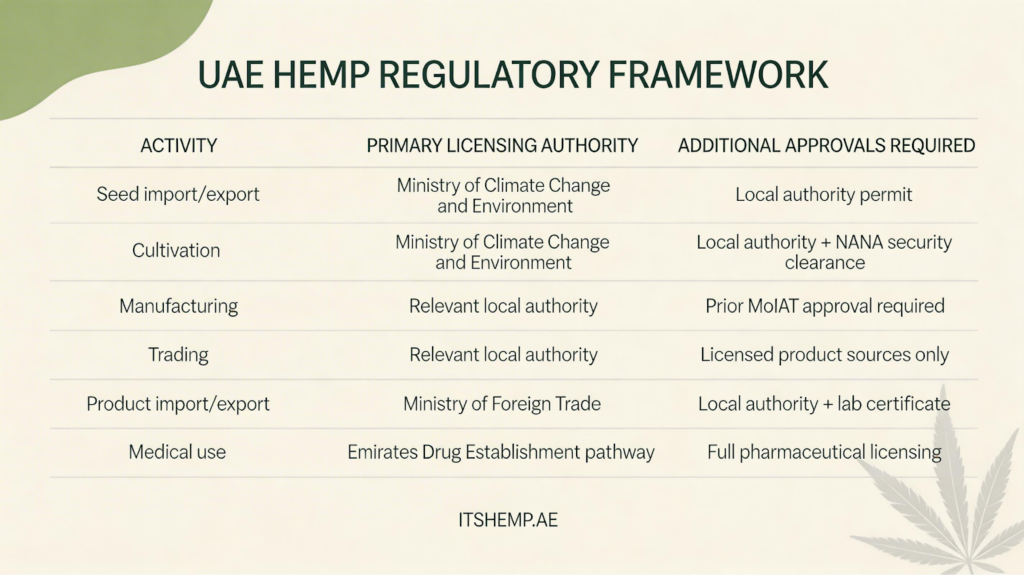
This multi-agency architecture is not bureaucratic inefficiency. It is a deliberate design choice, one that ensures oversight from multiple government bodies at every stage of the hemp supply chain.
3g. The National Tracking System
One of the most distinctive and far-reaching features of the UAE hemp law is the mandatory National Tracking System.
The law requires the creation of a national electronic registry covering all industrial hemp seeds, seedlings, and products, from the moment seeds are planted, through every stage of cultivation, manufacturing, transport, and final sale or export.
This track-and-trace infrastructure, governed by Cabinet decision, is accessible to all relevant federal and local authorities at all times. It means that every licensed actor in the UAE hemp supply chain generates a continuous data trail that is visible to regulators in real time.
For businesses, this has profound practical implications. Comprehensive record-keeping is not optional. It is not a best practice recommendation. It is a mandatory licensing condition and a legal obligation. Records must be maintained for a minimum of five years. Failure to maintain accurate records is itself a violation subject to penalties.
3h. The Role of Individual Emirates
Federal Decree-Law No. 24 establishes a national framework, but it explicitly preserves each emirate’s authority to prohibit or restrict hemp activities within its own jurisdiction.
This means that a federal licence to cultivate hemp, for example, does not automatically entitle the holder to cultivate hemp in every emirate. If Dubai imposes additional restrictions on hemp cultivation within its territory, the federal licence does not override those restrictions.
As of early 2026, emirate-specific implementing regulations are still being developed. Businesses operating across multiple emirates must engage with local authorities in each relevant emirate and monitor emirate-level government publications for hemp-specific orders.
Chapter 4: What is Legal in the UAE?
This is the chapter most UAE residents, expats, and business owners have been waiting for. The question is simple. The answer, unfortunately, is not.
The UAE’s 2026 hemp law did not create a free, open hemp market. It created a tightly controlled, licence-dependent framework within which specific industrial and medical activities are now permitted. Understanding exactly what falls inside that framework, and what does not, is essential for anyone living in, working in, or visiting the UAE.
Here is a clear, honest, and comprehensive breakdown of legal hemp products in the UAE.
4a. Hemp Seed Oil in Cosmetics, Legal
This is the one area where legal clarity predates the 2026 law entirely.
Since January 2019, pure hemp seed oil, derived from cold-pressing hemp seeds, containing absolutely no THC and no CBD, has been legally permitted for use in cosmetic products in the UAE. Skincare serums, facial oils, lip balms, moisturisers, shampoos, and body care products that list pure hemp seed oil as an ingredient have been legally available in the UAE for several years.
The 2026 law maintains and codifies this permission. It is now formally embedded in the national hemp regulatory framework.
The critical word here is pure. The permission applies specifically to oils extracted from hemp seeds or stalks that are entirely free from THC and any compounds capable of producing a narcotic or psychoactive effect. The moment a cosmetic product contains hemp extract, CBD, or any detectable THC, it moves outside this permission and into prohibited territory.
For consumers, this means one very practical thing: when buying skincare products in the UAE, check the ingredient list carefully. Hemp seed oil and hemp extract are not the same thing legally. Hemp seed oil is permitted. Hemp extract, CBD, and cannabidiol are not.
4b. Industrial Hemp for Licensed Businesses, Legal with Licensing
For the first time in UAE history, businesses can now legally work with industrial hemp, provided they obtain the appropriate licences from the relevant authorities.
The industrial sectors where hemp use is authorised under the law are:
Textiles and Fashion
Hemp fibre can now be used in the manufacture of fabric, clothing, and technical textiles within the UAE, by licensed manufacturers who have obtained the necessary approvals from local authorities and the Ministry of Industry and Advanced Technology. Hemp’s extraordinary fibre strength, breathability, and antibacterial properties make it a compelling raw material for the textile industry. The global shift towards sustainable fashion makes this a particularly significant opportunity for the UAE.
Construction and Building Materials
Hemp-derived construction materials, most notably hempcrete, which is made by combining the woody inner core of the hemp stalk with lime and water, are now legally manufacturable in the UAE under licence. Hempcrete is lightweight, carbon-negative, thermally insulating, and non-toxic. As the UAE continues to build, develop, and position itself as a leader in sustainable urban development, licensed hemp construction material manufacturing represents a genuine industrial opportunity.
Paper and Packaging
Hemp-based paper products and hemp packaging materials can now be legally manufactured in the UAE under licence. One acre of hemp produces the equivalent paper yield of ten acres of trees, in four to five months rather than decades. As the global packaging and paper industry faces growing pressure to reduce its environmental footprint, hemp offers a compelling alternative that the UAE is now legally positioned to produce.
Medical Products
For the first time, hemp compounds, including CBD, can be used as ingredients in licensed pharmaceutical products manufactured in the UAE. This pathway is subject to the full rigour of Federal Decree-Law No. 38 of 2024 on Medical Products. It is not a consumer wellness market. It is a pharmaceutical manufacturing pathway, one that could eventually position the UAE as a producer of pharmaceutical-grade hemp compounds for the regional and global market.
4c. Hemp Cultivation, Legal with Strict Licensing
Hemp cultivation is now legally possible in the UAE. This is genuinely historic. But the conditions attached to that legality are extraordinary.
To legally cultivate industrial hemp in the UAE, a business must:
- All owners and partners of the applying entity must be at least 21 years old, of good conduct, and must not have been previously convicted of a felony or a misdemeanor involving moral turpitude or breach of trust, unless their legal standing has been formally restored
- Obtain a cultivation licence from the Ministry of Climate Change and Environment
- Obtain a permit from the relevant local authority in the emirate where cultivation will take place
- Obtain a security clearance from the National Anti-Narcotics Authority
- Designate cultivation areas that are fenced, monitored, and isolated from residential areas and other agricultural land
- Comply with strict quantity and production limits
- Conduct periodic THC testing throughout the growing cycle
- Report any THC exceedance immediately to the Ministry of Climate Change and Environment, the relevant local authority, and the National Anti-Narcotics Authority
- Maintain comprehensive records for a minimum of five years
- Submit quarterly periodic reports to the licensing authority
This is not a framework designed for small-scale or casual cultivation. It is a framework designed for serious, well-capitalised agricultural operators with strong compliance capabilities and the resources to invest in the infrastructure that compliant cultivation requires.
4d. Hemp Trading and Distribution, Legal with Licensing
Licensed traders can buy and sell authorised hemp products within the UAE, but only products that have been produced or imported through properly licensed channels.
Full labelling requirements apply to all traded hemp products, including the use of the official Industrial Hemp Symbol. Disposal of hemp products, including end-of-life or surplus stock, must follow approved contract templates. Every transaction must be documented, and records must be maintained for five years.
This means that any hemp product sold in the UAE must have a verifiable, documented origin within the licensed supply chain. Products that cannot demonstrate this provenance, regardless of their THC content or apparent innocuousness, cannot be legally traded.
4e. Hemp Import and Export, Legal with Licensing
Licensed businesses can import and export hemp products, subject to approval from the Ministry of Foreign Trade and the relevant local authority.
Every hemp product crossing the UAE border requires a certificate from a Ministry of Industry and Advanced Technology-accredited laboratory confirming that total THC does not exceed 0.3%. For exports, the additional requirement of approval from the competent government authority in the destination country applies.
Hemp seeds, specifically seeds, not seedlings, can be imported by licensed agricultural companies for use in designated cultivation areas.
4f. Medical Hemp Through Prescription, Legal for Specific Patients
The 2026 law creates, for the first time, a legal pathway for specific hemp-derived pharmaceutical products to be prescribed by licensed UAE physicians and dispensed through licensed UAE pharmacies.
This is a genuinely significant development, but it is important to understand precisely what it does and does not mean.
It means that a patient with a specific medical condition for which a hemp-derived pharmaceutical has been approved, through the full pharmaceutical regulatory process, may, through a licensed physician and a licensed pharmacy, access that product legally in the UAE.
It does not mean that CBD oil is available over the counter. It does not mean that hemp supplements are available in pharmacies. It does not mean that any hemp wellness product can be self-prescribed or purchased independently.
The medical hemp pathway is a pharmaceutical pathway. It operates through the same rigorous regulatory framework that governs every other prescription medicine in the UAE. The most commonly discussed potential product in this category is a CBD-based pharmaceutical similar to medications approved in other jurisdictions for treatment-resistant epilepsy. As of early 2026, the specific products that will be made available through licensed UAE medical channels remain subject to the ongoing pharmaceutical approval process.
An Important Distinction: Medical CBD vs Consumer CBD
Before going further, one clarification is essential, because this section is frequently misread as suggesting that CBD is now broadly available in the UAE.
It is not.
What the 2026 law creates is a pharmaceutical pathway, not a consumer market. CBD as an ingredient in a licensed medicine is fundamentally different from CBD oil sold in a health store. The former is a regulated pharmaceutical product, prescribed by a doctor, dispensed by a pharmacy, and subject to the full rigour of the UAE medical products law. The latter remains completely prohibited.
A UAE resident cannot buy CBD oil because this section exists. They cannot import CBD supplements. They cannot self-prescribe hemp products for wellness purposes. What they may eventually be able to access, through a licensed physician, for a specific qualifying medical condition, once the pharmaceutical approval process has been completed, is a CBD-based medicine formally approved through UAE regulatory channels.
That is a meaningful development. It is also a very narrow one.
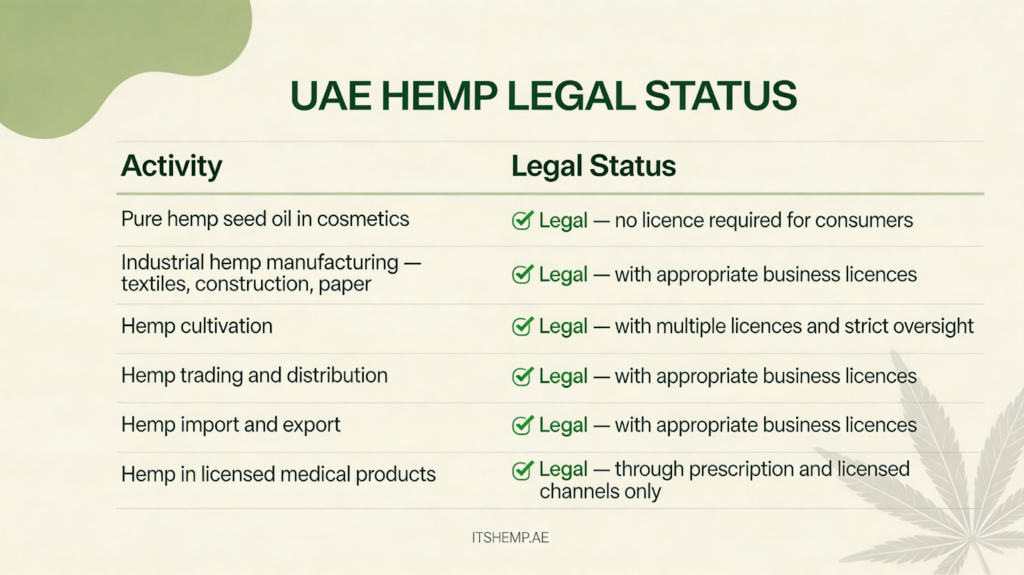
4g A Summary, What is Legal
To bring this chapter into sharp focus, here is a clear summary of what is legal in the UAE as of 2026:
Chapter 5: What is Still Illegal in the UAE?
Understanding what remains prohibited under the UAE’s new hemp law is just as important, arguably more important, than understanding what is now permitted.
The 2026 legalisation has generated significant excitement and no small amount of confusion. Social media posts, international news articles, and well-meaning but poorly informed conversations have left many UAE residents with the impression that hemp products are now freely available, that CBD oil can be purchased openly, and that the rules around cannabis have fundamentally relaxed.
They have not.
This chapter exists to correct that misunderstanding, clearly, directly, and without ambiguity. Because in the UAE, misunderstanding the law is not just an intellectual error. It is a risk with consequences that can include criminal prosecution, imprisonment, and deportation.
5a. Consumer Hemp Products, Still Illegal
This is the most important thing for the vast majority of UAE residents to understand.
The consumer hemp market that exists in the United Kingdom, the United States, Canada, Australia, India, and much of Europe, where you can walk into a health food store, a pharmacy, or an online shop and purchase CBD oil, hemp protein powder, hemp gummies, or hemp supplements, does not exist in the UAE. It is not coming in 2026. There is no timeline for its arrival.
The UAE’s 2026 hemp law created a licensing framework for industrial and medical hemp businesses. It did not create a consumer market. It did not legalise hemp products for personal use. It did not open a pathway for residents to buy hemp wellness products freely.
The following consumer product categories remain explicitly and comprehensively prohibited:
Hemp Food Products, Mostly Prohibited, With One Important Exception
Hemp food products are largely prohibited in the UAE under Federal Decree-Law No. 24 of 2025. However, the law contains one specific and legally significant exception that must be clearly understood.
The Exception, Roasted or Processed Non-Viable Hemp Seeds
The law explicitly permits roasted or processed hemp plant seeds that have been rendered non-viable, meaning seeds that have been treated in a way that prevents them from germinating. This exception is stipulated in Schedule No. 1 of the law and represents a narrow but meaningful carve-out from the general food prohibition.
In plain terms, a roasted hemp seed that cannot grow into a plant is treated differently from a raw, viable hemp seed under UAE law. The rationale is straightforward: a non-viable seed poses no cultivation risk and carries no meaningful relationship to drug production.
What Remains Prohibited:
- Raw hemp seeds sold for human consumption
- Hemp protein powder
- Hemp milk
- Hemp seed oil is sold as a dietary supplement or cooking oil
- Hemp-infused foods of any kind, chocolates, energy bars, granola, pasta, bread
What the Exception Covers:
- Roasted hemp seeds, rendered non-viable through heat processing
- Processed hemp seeds, rendered non-viable through other approved processing methods
- Subject to conditions specified in Schedule No. 1 of the law
An Important Practical Note
The specific conditions governing this exception, including what processing methods qualify, what documentation is required, and how non-viability must be demonstrated, are detailed in Schedule No. 1 of the law and in the executive regulations still being developed. Anyone seeking to import, manufacture, or sell roasted hemp seeds in the UAE should seek qualified legal advice to ensure full compliance with these specific requirements before proceeding.
This prohibition extends to products purchased legally in other countries and brought into the UAE for personal use. The legality of a hemp food product in its country of origin is entirely irrelevant to its legal status in the UAE.
Consumer CBD, Prohibited. Pharmaceutical CBD, A Narrow Exception.
This is the distinction that causes more confusion than any other single point in UAE hemp law, and it must be understood precisely.
CBD exists in two entirely different legal categories in the UAE. They are not the same thing. They are not interchangeable. And confusing them can have serious legal consequences.
Consumer CBD, Prohibited
CBD oil purchased off a shelf, ordered online, or brought from abroad, in any form, at any concentration, regardless of THC content, is prohibited in the UAE for personal use. This includes CBD tinctures, CBD capsules, CBD gummies, CBD-infused skincare, and CBD pet products. No consumer retail pathway for CBD exists in the UAE.
Pharmaceutical CBD, A Narrow Exception
The 2026 law creates a legal pathway for CBD to be used as an ingredient in licensed pharmaceutical products only. This means:
- A licensed UAE pharmaceutical manufacturer may produce a CBD-based medicine
- A licensed UAE physician may prescribe it for a specific qualifying medical condition
- A licensed UAE pharmacy may dispense it to that patient
This does NOT mean CBD oil is available over the counter. It does NOT mean hemp supplements are in pharmacies. It does NOT mean any CBD wellness product can be purchased or imported.
5b. Bringing Hemp Products Into the UAE, Still Illegal
This is where many UAE residents and travellers make dangerous assumptions.
The 2026 hemp law did not create any personal import pathway for hemp products. There is no provision that allows a UAE resident to bring hemp products purchased legally abroad into the country for personal use. There is no quantity threshold below which personal import is tolerated. There is no amnesty for products purchased before the law came into force.
The practical implications of this are significant and must be understood clearly.
Travelling from Countries with Legal Hemp Markets
If you are returning to the UAE from the United Kingdom, where CBD oil is legal and widely available, you cannot bring it with you. If you are returning from Canada, where hemp food products are sold in every supermarket, you cannot bring them with you. If you are returning from India, where hemp seeds are legally sold as food, you cannot bring them with you.
UAE customs officers actively screen for cannabis-derived products at all points of entry. Detection is a real risk. The consequences of detection, criminal charges, potential imprisonment, and mandatory deportation for foreign nationals are wholly disproportionate to any perceived benefit of bringing a wellness product through the border.
Transit Through UAE Airports
This is perhaps the least understood prohibition of all. If you are transiting through Dubai International Airport, Abu Dhabi International Airport, or any other UAE airport, UAE law applies during your time in that airport. A passenger travelling from Amsterdam to Nairobi with a layover in Dubai, carrying legally purchased CBD products, is subject to UAE law during that layover.
This applies even if your luggage is checked through to your final destination. If your bags are screened at a UAE airport and cannabis-derived products are found, the fact that you are in transit is not a defence.
Existing Products at Home
If you are a UAE resident who currently has hemp-derived consumer products at home, such as CBD oil, hemp supplements, or hemp edibles, that were purchased before the new law or imported from abroad, the legally safest course of action is to dispose of them properly. The new law created no amnesty period for pre-existing prohibited products.
5c. Activities That Remain Categorically Prohibited
Beyond consumer products, certain specific activities remain absolutely prohibited under the new law, regardless of whether a business holds any licence.
Import and Export of Hemp Seedlings
Hemp seeds may be imported and exported by licensed agricultural companies. Hemp seedlings, young plants that have already germinated, may not. This prohibition is categorical and applies to all parties without exception.
Cultivation Outside Approved Zones
Hemp may only be cultivated in areas specifically designated and approved by local authorities. Cultivating hemp anywhere outside these designated zones, regardless of the THC content of the plants, is a criminal offence.
Disposal to Unlicensed Parties
Hemp seeds, seedlings, or products may not be disposed of, sold, given, or transferred in any way to any party that does not hold the appropriate licence. This applies even to end-of-life or surplus stock. Disposal must follow approved contract templates and documented procedures.
Personal and Recreational Use
This bears repeating with absolute clarity: personal or recreational use of hemp or cannabis, in any form, at any THC level, under any circumstances, remains strictly and completely illegal in the UAE. The 2026 law changed nothing in this regard. Zero tolerance means zero tolerance.
5d. The Free Zone Misconception
A significant number of businesspeople operating in the UAE free zones have asked whether their free zone status provides any exemption from the hemp law’s prohibitions.
It does not.
Federal Decree-Law No. 24 of 2025 explicitly states that it applies to all industrial hemp-related activities conducted within the UAE, and this jurisdiction expressly includes free zones. Dubai International Financial Centre, Dubai Multi Commodities Centre, Abu Dhabi Global Market, Jebel Ali Free Zone, and every other special economic zone in the country are within scope.
A hemp business established in a UAE free zone is not exempt from licensing requirements. It is not exempt from the prohibited product categories. It is not exempt from the THC testing requirements, the record-keeping obligations, or the criminal penalties for violations.
A free zone location may offer administrative advantages in terms of business setup and trade processing. It offers no legal shield from the hemp law.
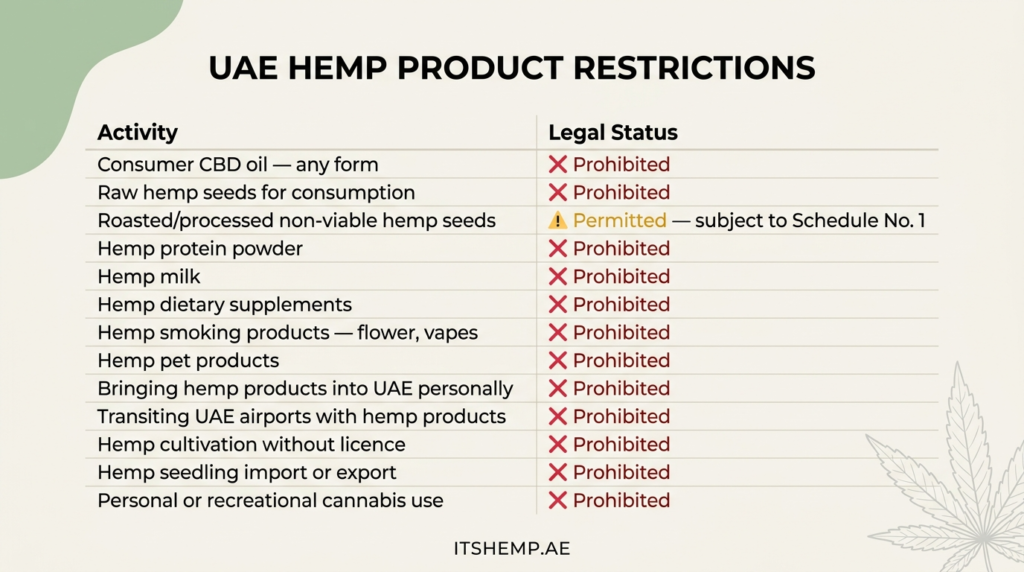
5e. A Summary, What Remains Illegal
Chapter 6: What This Means for UAE Residents
The previous chapters have covered the law in detail, what it permits, what it prohibits, and how the licensing framework operates. This chapter brings all of that information down to the level that matters most for the majority of people reading this guide.
You. The person living in the UAE.
Whether you are an Emirati national, a long-term expat, a recent arrival, or a visitor passing through, this chapter answers the questions you are actually asking. Clearly, honestly, and without legal jargon.
6a. The Single Most Important Thing to Understand
Before diving into specific scenarios, one overarching reality needs to be stated plainly.
The 2026 UAE hemp law was primarily written for businesses, with very limited and narrow exceptions for consumers.
It created licensing pathways for industrial hemp manufacturers, agricultural operators, pharmaceutical companies, and traders. It did not create a consumer market. It did not legalise hemp products for personal use. It did not open any pathway for UAE residents to freely purchase, possess, or use hemp products in their daily lives.
If you are a UAE resident hoping to buy hemp seeds at your local supermarket, order CBD oil online, or bring your hemp supplements through Dubai airport without consequence, the 2026 law has not changed your situation. Not yet. Possibly not for a long time.
This is not a pessimistic reading of the law. It is an accurate one. And in a country where the consequences of getting this wrong include criminal prosecution and deportation, accuracy matters more than optimism.
6b. Can I Buy Hemp Products in UAE Shops?
The short answer is: very limited options, and only in specific categories.
What you can buy:
Pure hemp seed oil cosmetics, facial oils, moisturisers, lip balms, shampoos, and body care products containing pure hemp seed oil with no THC and no CBD, have been legally available in UAE cosmetic shops and pharmacies since 2019. These products are permitted and have been for years. If you are already using a hemp seed oil skincare product purchased in the UAE, you are almost certainly using something that is and has always been legal.
What you cannot buy:
Hemp food products are not legally available for consumer purchase in UAE supermarkets or health food stores. Hemp protein powder, hemp seeds sold as food, hemp milk, hemp oil sold as a dietary supplement, none of these are legally available through consumer retail channels in the UAE.
Consumer CBD products, oils, tinctures, gummies, and capsules are not legally available in UAE pharmacies, health stores, or online retailers shipping to UAE addresses.
If you encounter a shop, website, or individual claiming to sell consumer hemp supplements or CBD products legally in the UAE, exercise extreme caution. The legal framework simply does not support such claims at this stage.
6c. Can I Bring Hemp Products Into the UAE?
No.
This answer deserves no qualification, no nuance, and no softening. Bringing consumer hemp products into the UAE, in your luggage, in your carry-on, in a parcel sent by post, or by any other means, carries real, serious, life-altering legal risk.
It does not matter that the product is legal where you bought it. It does not matter that the product contains 0% THC. It does not matter that you have a medical reason for using it. It does not matter that the quantity is small. It does not matter that you have been using the product for years without issue.
UAE customs officers actively screen for cannabis-derived products. Detection rates are high. The consequences, criminal charges, potential imprisonment, and mandatory deportation for foreign nationals, are severe and disproportionate by the standards of most Western countries. But they are the law of the UAE, and they apply equally to every person who enters the country.
Do not bring hemp or CBD products into the UAE. This advice has not changed with the 2026 law. It will not change until there is a specific, explicit consumer import pathway, which does not currently exist.
6d. What About Hemp Products I Already Have at Home?
If you are a UAE resident who currently has consumer hemp products at home, CBD oil, hemp supplements, or hemp food products purchased before the new law or imported from abroad, the legally safest course of action is clear.
Dispose of them.
The 2026 law created no amnesty period for pre-existing prohibited products. Possession of prohibited hemp-derived consumer products remains a violation of UAE law regardless of when they were purchased or where they came from.
This may feel disproportionate. It may feel unfair. But the legal reality is what it is, and the risk of retaining these products is not one that any responsible guide can advise you to accept.
6e. Can I Use Hemp Products for Health or Wellness Purposes?
Not through the channels most people in other countries use.
There is no legal pathway in the UAE for a resident to purchase CBD oil, hemp wellness drops, or hemp supplements for self-directed health management. The wellness hemp market that exists in the UK, USA, India, and much of Europe has no legal equivalent in the UAE.
If you have a specific medical condition for which a hemp-derived pharmaceutical product has been clinically approved, the most documented example being treatment-resistant epilepsy, the pathway is through a licensed UAE physician and the pharmaceutical regulatory system.
This means:
- Consulting a licensed UAE doctor about your condition
- Having the doctor determine whether a hemp-derived pharmaceutical is appropriate for your situation
- Accessing that product, if approved, through a licensed UAE pharmacy
This pathway exists in principle under the 2026 law. In practice, as of early 2026, the specific pharmaceutical products that will be available through UAE medical channels are still being determined through the ongoing regulatory approval process. The pathway is real, but the products available through it are limited and will develop over time.
6f. Can I Use Hemp Seed Oil Skincare Products?
Yes, with an important qualification.
Pure hemp seed oil cosmetics have been legal in the UAE since 2019 and remain legal under the 2026 framework. If you are buying or using a skincare product that contains hemp seed oil as an ingredient, and that product contains no THC, no CBD, and no hemp extract, you are using a legal product.
The qualification is this: always check the ingredient list carefully. The difference between hemp seed oil and hemp extract or cannabidiol is legally significant in the UAE. A product labelled as hemp skincare that contains CBD or hemp extract is not the same as a product containing pure hemp seed oil, and the former is prohibited while the latter is permitted.
When in doubt, look for products that specifically state hemp seed oil in their ingredient list and carry no mention of CBD, cannabidiol, or hemp extract. These are the products that fall within the permitted category.
6g. What if I am travelling through an UAE Airport?
This is one of the most important and least understood aspects of UAE hemp law for international travellers.
If you are transiting through Dubai International Airport, Abu Dhabi International Airport, Sharjah International Airport, or any other UAE airport, UAE law applies to you and your belongings during the entire time you are in that airport.
This means that a passenger travelling from Amsterdam to Bangkok with a layover in Dubai, carrying legally purchased CBD products, is subject to the UAE narcotics law during their layover. If those products are discovered during baggage screening, the fact that you are in transit is not a legal defence.
This applies even if your luggage is checked through to your final destination and you do not collect it during your layover. Screening can occur at any point.
If you are transiting through an UAE airport and you have hemp or CBD products in your luggage, remove them before your journey and do not bring them. This is not a risk worth taking under any circumstances.
Chapter 7: What This Means for Businesses and Entrepreneurs
The UAE’s 2026 hemp law has generated enormous excitement in the business community, and for good reason. For the first time, a regulated industrial hemp sector exists in one of the world’s most strategically positioned, business-friendly, and financially sophisticated markets.
But excitement without clarity is dangerous. And in a regulatory environment as precise and unforgiving as the UAE’s, the difference between a legitimate hemp business opportunity and a serious legal risk often comes down to details that most enthusiastic entrepreneurs have not yet considered.
This chapter is for anyone thinking seriously about building a hemp business in the UAE, whether you are an Emirati national, a long-term resident, an international investor, or a global hemp company considering market entry. It covers the real opportunities the law creates, the practical realities of pursuing them, and the steps any serious operator should take before committing capital or making commitments.
7a. The Nature of the Opportunity, What Kind of Market Is This?
The first thing any prospective hemp entrepreneur in the UAE needs to understand is what kind of market the 2026 law actually creates.
It is not a mass consumer market. It is not a wellness retail opportunity. It is not a CBD shop waiting to happen.
The UAE hemp market created by Federal Decree-Law No. 24 of 2025 is a sophisticated industrial and pharmaceutical market, one designed for operators with strong compliance capabilities, technical expertise, significant capital, and the patience to navigate a complex multi-agency licensing process.
The businesses that will thrive in this environment are not startups hoping to ride a consumer hemp wave. They are serious industrial operators, pharmaceutical manufacturers, agricultural enterprises, and logistics companies that can meet the UAE government’s exacting standards for licensing, tracking, testing, and record-keeping.
This is not a discouraging reality. It is simply an accurate one, and understanding it from the outset is the foundation of any serious UAE hemp business strategy.
7b. Real Business Opportunities Under the Law
Within the framework created by the 2026 law, several genuine business opportunities exist. Here is an honest assessment of each.
Hemp Textiles Manufacturing
Hemp fibre is one of the strongest, most durable, and most sustainable natural fibres on earth. The global fashion and textiles industry is under increasing pressure to reduce its environmental footprint, and hemp offers a compelling alternative to cotton, polyester, and other conventional fibres.
A licensed hemp textiles manufacturer in the UAE would be positioned to supply both the domestic market and the broader regional market across the Middle East, Africa, and South Asia. The UAE’s world-class logistics infrastructure, with Dubai and Abu Dhabi serving as global shipping hubs, makes this a particularly attractive manufacturing location for export-oriented production.
The requirements to pursue this opportunity include a manufacturing licence from the relevant local authority, prior approval from the Ministry of Industry and Advanced Technology, a compliant manufacturing facility with separate hemp processing zones, and quality management systems.
A Critical Compliance Obligation, Dual THC Testing
One manufacturing obligation that is frequently underestimated, and must be clearly understood before any capital is committed, is the law’s dual THC testing requirement. Licensed manufacturers are legally required to conduct periodic THC testing at two distinct stages of their operation: on raw materials when they are received, and on finished products before they leave the facility. Testing at one stage alone does not satisfy the legal obligation. Both must be tested, both must remain below 0.3% total THC, and any exceedance at either stage must be reported immediately to the licensing authority and the National Anti-Narcotics Authority.
For a textiles manufacturer, this means that incoming hemp fibre must be tested before processing begins, and the finished fabric or garment must be tested before it is shipped or sold. The infrastructure, laboratory accreditation, and quality management systems required to support this dual-testing obligation are not trivial. They must be built into the facility design and operational budget from day one.
The capital investment required is significant. The compliance obligations are ongoing and non-negotiable.
Hemp Construction Materials
Hempcrete, the lightweight, carbon-negative, thermally insulating building material made from hemp stalks and lime, is gaining serious traction in the global construction industry. As sustainability becomes an increasingly central concern in building and development, hempcrete offers architects, developers, and contractors a genuinely differentiated material.
The UAE construction sector is one of the most active in the world. A licensed hempcrete manufacturer in the UAE would be positioned to supply a domestic market that is continuously building hotels, residential towers, commercial developments, and infrastructure, while also serving the broader regional market.
The pathway requires a manufacturing licence, Ministry of Industry and Advanced Technology (MoIAT) approval, quality systems aligned with UAE construction standards, and the technical expertise to produce hempcrete that meets the specific performance requirements of UAE building environments, including the extreme heat conditions that characterise the Gulf climate.
Hemp Packaging and Paper
The global packaging industry is under sustained pressure from both regulators and consumers to reduce plastic use and adopt sustainable alternatives. Hemp-based paper and packaging offer genuine environmental advantages; one acre of hemp produces the equivalent paper yield of ten acres of trees, in a fraction of the time, without the deforestation consequences.
A licensed hemp packaging manufacturer in the UAE would be positioned to serve the country’s substantial retail, food and beverage, e-commerce, and logistics sectors, all of which are under growing pressure to demonstrate sustainability credentials.
Pharmaceutical Hemp Manufacturing
This is the highest-complexity, highest-investment, and potentially highest-value opportunity in the UAE hemp landscape.
The 2026 law permits hemp compounds to be used as ingredients in licensed pharmaceutical products. This creates a pathway, in principle, for the manufacture of pharmaceutical-grade CBD and other hemp-derived compounds in the UAE for use in licensed medicines.
The requirements are extraordinary. Full pharmaceutical-grade manufacturing standards apply. Every aspect of production, testing, quality assurance, and distribution must meet the standards set by Federal Decree-Law No. 38 of 2024 on Medical Products. The capital investment required is substantial. The regulatory timeline is long. The expertise required is highly specialised.
But for pharmaceutical companies with the resources and expertise to pursue it, the UAE’s strategic location, tax environment, and government support for healthcare sector development make this a compelling long-term opportunity.
The Dual THC Testing Obligation, Particularly Critical for Pharmaceutical Manufacturers
For pharmaceutical hemp manufacturers, the dual THC testing obligation prescribed by the law carries particular weight. Licensed manufacturers must conduct periodic THC testing on both raw hemp materials, as they are received and before they enter the production process, and on finished pharmaceutical products before they are released into licensed distribution channels.
In a pharmaceutical manufacturing context, where precision, documentation, and regulatory traceability are already foundational requirements, this dual-testing obligation integrates into existing quality management frameworks. But it adds a layer of hemp-specific compliance, including the requirement to report any THC exceedance to both the licensing authority and the National Anti-Narcotics Authority, that goes beyond standard pharmaceutical quality control and must be specifically designed into the manufacturing compliance programme.
For any company considering pharmaceutical hemp manufacturing in the UAE, this dual obligation is not an afterthought. It is a core compliance requirement that shapes facility design, laboratory infrastructure, staff training, and operational procedures from the outset.
Industrial Hemp Seed Import and Export
The UAE’s position as a global trade and logistics hub creates a natural opportunity in the import and export of industrial hemp seeds, for use in cultivation operations across the region and beyond.
A licensed seed import and export business would need to be a registered agricultural company, obtain licences from the Ministry of Climate Change and Environment and the relevant local authority, work exclusively with seeds from approved industrial hemp varieties, and maintain comprehensive documentation for every seed shipment.
Hemp Product Trading and Distribution
For businesses not seeking to manufacture hemp products but to trade in them, importing licensed hemp products and distributing them to licensed industrial customers within the UAE, the law creates a trading licence pathway.
This is a less capital-intensive entry point into the UAE hemp market than manufacturing. But it comes with its own compliance requirements, licensed product sources only, full labelling and documentation compliance, five-year record retention, and approved disposal procedures for any surplus or end-of-life stock.
7c. The Licensing Reality, What Businesses Actually Need to Do
Every business opportunity described above requires navigating the UAE’s multi-agency licensing framework. This is not a simple process, and businesses that underestimate its complexity do so at high cost.
Here is a practical framework for how any serious hemp business should approach the UAE market.
Step 1: Engage Qualified Legal Counsel First
Before any other step, before any capital commitment, before any conversations with potential partners or investors, engage a UAE-qualified legal advisor with specific experience in hemp or pharmaceutical regulatory matters.
The multi-agency licensing architecture of the UAE hemp law is complex. The consequences of getting it wrong include criminal liability. This is not a situation where general business legal advice is sufficient. Specialist guidance is essential.
Step 2: Define Your Specific Activity With Precision
The licensing requirements, costs, timelines, and regulatory bodies involved differ significantly between different hemp activities. The pathway for a hemp textiles manufacturer is entirely different from the pathway for a pharmaceutical hemp producer or a seed importer.
Before engaging with regulators, be completely precise about what activity you intend to pursue. Vague intentions to be broadly “in hemp” will not serve you well in a regulatory environment that requires precise activity definitions.
Cross-Emirate Transport
To illustrate why precision matters, consider transport. A business that plans to cultivate hemp seeds in one emirate and process them in another, a perfectly logical operational structure in the UAE’s industrial landscape, faces a compliance requirement that is easy to overlook but impossible to ignore once operations begin.
Transport of seeds and seedlings is prohibited without approval from the competent local authority. Where transport occurs across more than one emirate, approval must be obtained from each relevant authority involved.
This means that a shipment of hemp seeds moving from Dubai to Abu Dhabi requires two separate approvals, one from each emirate’s competent local authority, before the transport can legally proceed. A business that has planned its supply chain without accounting for this requirement will find itself unable to move its product legally until it has obtained both approvals, a process that takes time and resources that must be factored into operational planning from the very start.
This is precisely why identifying your specific activity with precision and understanding every regulatory touchpoint that activity involves is not a preparatory step to be rushed. It is the foundation on which your entire UAE hemp business must be built.
Step 3: Engage Early With Relevant Regulatory Bodies
The executive regulations for Federal Decree-Law No. 24 are still being developed and published throughout 2026. Early engagement with relevant ministries and local authorities will help you understand the current state of regulatory requirements, identify what is already clear and what is still being determined, and build the relationships that any serious regulated business needs with its oversight authorities.
Step 4: Assess the Free Zone Question Carefully
While free zones provide no exemption from the hemp law, some will develop hemp-specific support infrastructure, licensing facilitation, and industry clustering faster than others. Evaluating which UAE free zone, if any, best supports your specific hemp business model is worth careful consideration. This is an area where early legal and business advisory engagement is particularly valuable.
Step 5: Build Compliance Infrastructure From Day One
The UAE hemp law’s National Tracking System means that regulators have real-time visibility into licensed hemp supply chains. Record-keeping is not optional. THC testing is not optional. Reporting is not optional.
Businesses that attempt to build compliance infrastructure as an afterthought will find themselves unable to meet licensing conditions and exposed to the very serious penalties that the law prescribes for non-compliance. Compliance must be built into the business model from the very beginning, not added later.
Step 6: Monitor Regulatory Updates Continuously
The UAE hemp regulatory landscape will continue to evolve throughout 2026 and beyond. Executive regulations, Cabinet decisions, and emirate-level rules are being issued on an ongoing basis. Any serious hemp business in the UAE needs a systematic process for monitoring and responding to these developments, because what is unclear today may be clarified tomorrow, and what is permitted today could be restricted or expanded by future Cabinet action.
7d. What Businesses Should Not Do
Just as important as understanding what legitimate hemp businesses can do is understanding what they must not do, and why.
Do not proceed without specialist legal advice. The complexity of the UAE hemp licensing framework and the severity of the penalties for non-compliance make this non-negotiable.
Do not assume free zone status provides protection. It does not. Every provision of the hemp law applies in free zones.
Do not attempt to sell consumer hemp products. No licence currently exists that would permit the retail sale of CBD oil, hemp supplements, hemp food products, or similar consumer items. Any business that believes otherwise is mistaken or deliberately misleading.
Do not begin any hemp-related activity before licences are in place. Operating without the required licences is a criminal offence under Federal Decree-Law No. 24, with penalties starting at three months imprisonment and AED 100,000 in fines. There are no grace periods. There are no informal permissions. If you do not have the licence, you do not have the right to operate.
Do not rely on informal assurances. In a regulatory environment this precise, verbal assurances from individuals, however well-connected or well-intentioned, are no substitute for formal regulatory approval. Get everything in writing. Get everything confirmed by qualified legal counsel.
7e. The Long View, Where Is This Market Going?
For entrepreneurs and investors taking a long-term view, the UAE hemp market offers genuine and growing potential.
The alignment with international standards, the multi-ministry regulatory architecture, and the explicit connection to the UAE Centennial 2071 plan and the We the UAE 2031 roadmap all signal that this is a strategic commitment, not a temporary experiment.
As executive regulations are finalised, as licensing processes become more established, and as the first generation of licensed hemp businesses begins operating, the regulatory environment will become more navigable. The opportunities that exist only on paper today will become operational realities.
The businesses and investors that position themselves correctly now, with the right legal foundation, the right compliance infrastructure, and the right long-term perspective, will be best placed to benefit as the UAE hemp market matures.
This is a market in its earliest stages. The constraints are real. The compliance requirements are demanding. The timeline to meaningful commercial activity is longer than many enthusiastic commentators suggest. But the foundation is genuine, the direction is clear, and the UAE’s track record of building world-class regulated industries from scratch is second to none.
Chapter 8: Penalties, What Happens If You Get It Wrong?
The UAE hemp law is not a regulatory framework with soft edges. It is not a system that relies on warnings, second chances, or prosecutorial discretion. It is a precisely engineered legal structure with clearly defined consequences, consequences that are, by the standards of most countries, extraordinarily severe.
This chapter exists for one reason: to ensure that every person reading this guide, resident, expat, tourist, or business owner, understands exactly what is at stake when it comes to hemp law compliance in the UAE.
Understanding the penalties is not about fear. It is about making informed decisions. And in a country where a single mistake can result in imprisonment, financial ruin, and permanent deportation, informed decisions are the only kind worth making.
8a. Two Legal Frameworks, Why the Stakes Are So High
The first thing to understand about hemp law penalties in the UAE is that the new hemp law does not operate in isolation. It sits alongside and is layered on top of the pre-existing narcotics legislation.
This layering is critically important.
Federal Decree-Law No. 24 of 2025, the hemp law, establishes its own set of administrative and criminal penalties for violations of its specific provisions. But Federal Decree-Law No. 30 of 2021 on Combating Narcotics and Psychotropic Substances, the narcotics law, continues to apply in full force. Where a violation of the hemp law also constitutes a violation of the narcotics law, the narcotics law’s penalties apply, and they are significantly more severe.
In practical terms, this means that the penalties described in this chapter represent a range, from the administrative fines prescribed by the hemp law at the lower end, to the life imprisonment provisions of the narcotics law at the upper end. Where you fall within that range depends on the specific nature of the violation.
8b. Administrative Penalties, Under the Hemp Law
For regulatory violations, licensing failures, documentation errors, labelling non-compliance, and similar technical breaches, the hemp law prescribes a tiered system of administrative penalties.
Warning
A formal warning is the first-level administrative response for minor compliance issues. It is a notification that a violation has occurred and that corrective action is required. A warning does not carry a financial penalty but is formally recorded and escalates if the violation is not remedied.
Standard Administrative Fines
For more significant regulatory violations, including licensing breaches, documentation failures, labelling non-compliance, and failure to maintain required records, administrative fines range from AED 10,000 to AED 1,000,000.
It is critical to understand what “administrative” means here. Administrative fines apply to regulatory and compliance failures, paperwork errors, labelling violations, documentation gaps, and similar technical breaches. They are serious; a fine of AED 1,000,000 is approximately USD 272,000, but they are distinct from the criminal penalties that apply to more serious violations.
The difference between an administrative violation and a criminal violation is not always obvious, and in some cases, the same act can trigger both. This is precisely why legal counsel is essential for any business operating in the UAE hemp space.
Repeat Violation Fines
Where the same violation is committed after a prior finding, fines can reach AED 2,000,000, approximately USD 544,000. The UAE regulatory system takes repeated non-compliance extremely seriously.
Licence Suspension
Beyond financial penalties, the licensing authority can suspend a hemp operating licence, temporarily halting all hemp-related business activities until the violation is remedied and compliance is demonstrated. For a business whose entire operation is built around hemp activities, even a temporary suspension can cause severe commercial damage.
Licence Revocation
In the most serious cases of regulatory non-compliance, the licensing authority can permanently revoke a hemp operating licence. A revoked licence cannot be reinstated through a simplified process. The business’s ability to operate in the UAE hemp sector is permanently terminated.
8c. Criminal Penalties, Under the Hemp Law
Beyond administrative penalties, Federal Decree-Law No. 24 prescribes criminal penalties, including both imprisonment and fines, for specific serious violations.
The violations that carry criminal penalties under the hemp law include:
- Engaging in hemp-related activities without the required licence
- Misusing industrial hemp in activities other than those authorised under the law
- Transporting hemp seeds or seedlings without the required approvals
- Disposing of hemp seeds, seedlings, or products to an unlicensed party
- Using industrial hemp in prohibited products, including food, supplements, or smoking products
- Cultivating hemp outside approved zones or exceeding licensed quantities
- Providing false information to licensing authorities
- Failing to comply with approved contract templates for hemp disposal
The criminal minimum penalties under the hemp law are:
- Imprisonment of not less than 3 months
- A fine of not less than AED 100,000, approximately USD 27,225
- Either of these two penalties, meaning a court may impose imprisonment alone, or a fine alone, or both together
This is fundamentally different from the administrative fines in Chapter 8b.
To be completely clear about the distinction:
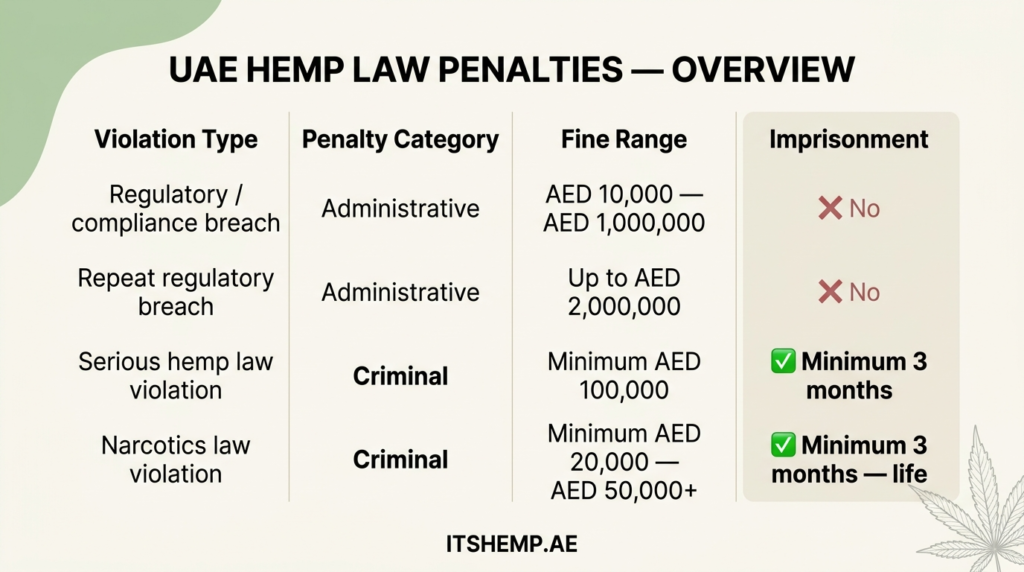
The AED 10,000 figure and the AED 100,000 figure are not alternatives; they apply to entirely different categories of violation. A business that misreads these numbers and assumes its worst-case exposure is AED 10,000 may be catastrophically underestimating its actual legal risk.
8d. Narcotics Law Penalties, Where the Stakes Become Existential
When a hemp law violation also constitutes a narcotics offence, which can happen whenever prohibited hemp products are involved, whenever unlicensed hemp activities resemble drug trafficking, or whenever THC thresholds are exceeded in ways that bring the substance within narcotics classification, the penalties of Federal Decree-Law No. 30 of 2021 apply.
These penalties are on an entirely different scale.
Personal Use, First Offence
For a first-time personal use offence involving a scheduled substance, the minimum penalty is 3 months imprisonment or a fine of AED 20,000. Courts have the discretion to substitute imprisonment with compulsory rehabilitation treatment for first-time offenders in some circumstances.
Personal Use, Repeat Offence
For repeat offenders within three years of a prior conviction, penalties escalate significantly. Courts can impose sentences of two years or more.
Drug Trafficking and Promotion
For offences that involve trafficking, promotion, or distribution of controlled substances, including hemp products that fall outside the authorised framework, the minimum penalty is 5 years imprisonment and a fine of AED 50,000. In the most severe trafficking cases, the penalty can escalate to life imprisonment.
Managing Premises for Drug Consumption
For individuals found to be managing premises used for drug consumption, a category that could theoretically apply to unlicensed hemp activities conducted on commercial premises, significant prison terms apply, with repeat offending potentially leading to life imprisonment.
Foreign Nationals, Additional Consequences
For the UAE’s expatriate population, approximately 88% of all residents, the consequences of a narcotics conviction extend beyond the sentence itself.
Foreign nationals convicted of narcotics offences face mandatory deportation after completing their sentence in the vast majority of cases. Judicial discretion to waive deportation is extremely limited. This means that for an expat resident, someone who may have lived in the UAE for years or decades, built a career, raised a family, and established a business, a narcotics conviction is not just a criminal matter. It is the permanent end of their life in the UAE.
Additionally, foreign nationals arriving at UAE entry points with prohibited substances, including hemp or CBD products, may face monetary fines under Cabinet Resolution No. 43 of 2024, with the possibility of entry bans that prevent future travel to or through the UAE.
8e. The Zero-Tolerance Culture, Why the Numbers Only Tell Part of the Story
The penalties described in this chapter are serious. But understanding UAE hemp law enforcement requires understanding something beyond the numbers, the enforcement culture within which those penalties operate.
The UAE operates a genuine, deeply embedded zero-tolerance approach to narcotics violations. This is not a rhetorical position. It is a lived operational reality that shapes how every aspect of the enforcement system functions.
In many Western jurisdictions, prosecutorial discretion plays a significant role in narcotics enforcement. Small quantities, first-time offenders, personal use contexts, and demonstrated remorse are all factors that commonly result in charges being reduced, diverted, or dropped entirely. The formal legal penalties exist, but the gap between those penalties and what actually happens in practice can be substantial.
In the UAE, that gap is essentially non-existent.
Customs screening at UAE airports is thorough, technologically sophisticated, and actively targets cannabis-derived products. Detection rates are high. Once a prohibited substance is detected, the legal process moves swiftly and predictably. Ignorance of the law has not historically been accepted as a meaningful defence. The quantity involved is often irrelevant to whether prosecution proceeds.
This is not a system designed to catch careless tourists and make an example of them. It is a system that reflects a deeply held societal and governmental commitment to narcotics control, one that predates the hemp law by decades and that the hemp law has done nothing to soften.
The practical implication of this culture for UAE residents and visitors is simple: the risk calculation around hemp and cannabis in the UAE is fundamentally different from the risk calculation in most other countries. What might be a minor inconvenience in Amsterdam or a dismissed charge in California is a life-altering event in Dubai or Abu Dhabi.
8f. A Summary, Penalties at a Glance
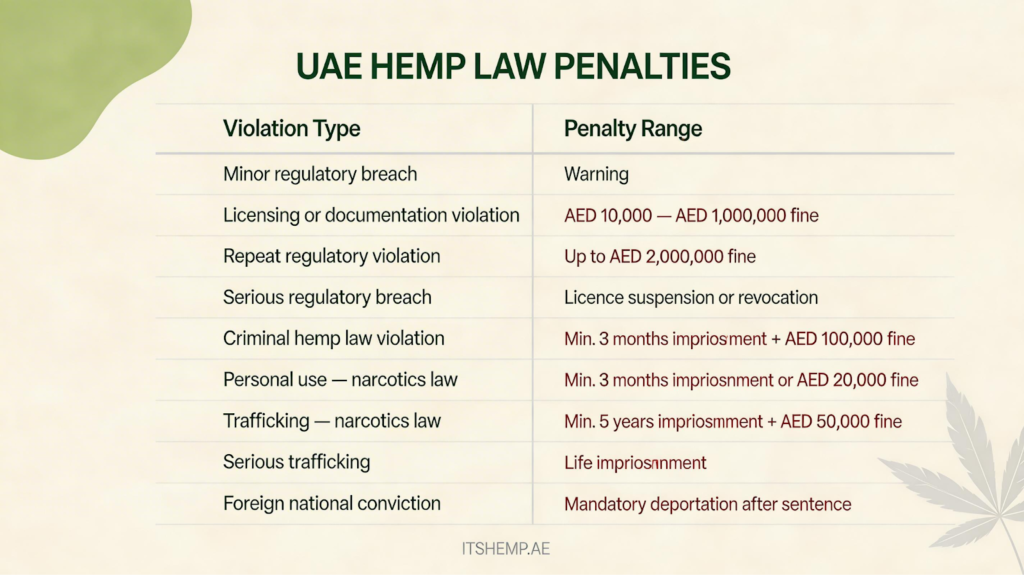
Chapter 9: UAE Hemp Laws vs The Rest of the World
The UAE did not legalise industrial hemp in a vacuum. It made a deliberate, considered decision to join a growing global movement, one that has been building momentum for decades across North America, Europe, Asia, and beyond.
Understanding where the UAE sits within that global picture serves two important purposes. For residents and expats, it explains why products that are freely available in their home countries are still prohibited in the UAE, and why that gap exists. For businesses and investors, it provides essential context for assessing the UAE’s position as a hemp market and identifying where genuine opportunities lie.
This chapter maps the UAE’s hemp framework against the world’s most significant hemp jurisdictions, honestly, accurately, and in a way that makes the comparisons genuinely useful.
9a. The Global Hemp Story: How the World Got Here
The story of hemp’s global rehabilitation is, in many ways, a story of science gradually overcoming politics.
For most of the 20th century, industrial hemp was caught in the crossfire of the global war on drugs. The 1961 Single Convention on Narcotic Drugs, the international treaty that shaped drug policy across the world for decades, treated cannabis as a controlled substance without meaningfully distinguishing between high-THC marijuana and low-THC industrial hemp. Countries that signed the treaty, which included virtually every nation on earth, were bound by its provisions. Hemp cultivation collapsed globally. Industries that had relied on hemp fibre, hemp seed, and hemp paper for centuries were dismantled.
The rehabilitation began slowly. Some European countries, most notably France, which never fully banned hemp cultivation, maintained small but active hemp fibre industries throughout the prohibition era. Others began quietly reintroducing hemp cultivation frameworks in the 1990s as the scientific case for distinguishing hemp from marijuana became increasingly difficult to ignore.
The pace accelerated dramatically in the 2010s. The United States, the country whose political influence had done more than any other to drive global hemp prohibition, began reversing course. The 2018 Farm Bill, which removed industrial hemp from the Controlled Substances Act and legalised its cultivation nationwide, was a watershed moment. It sent a signal to the rest of the world that the most powerful economy on earth had concluded that industrial hemp deserved its own legal framework, separate from marijuana, separate from the narcotics system, and open for business.
The UAE’s 2026 legalisation is part of this global story. It is a late but significant chapter in a rehabilitation that has been underway for three decades.
9b. The United States, The World’s Most Influential Hemp Market
The United States hemp market is, by virtually every measure, the most influential in the world, both in terms of its size and its impact on global hemp policy.
The 2018 Farm Bill removed industrial hemp and all its derivatives containing less than 0.3% THC from the Controlled Substances Act. It legalised hemp cultivation across all 50 states, subject to state-level regulation, and opened the door to a hemp products market that has grown rapidly in the years since.
The US hemp market encompasses food products, dietary supplements, CBD wellness products, cosmetics, textiles, construction materials, and industrial applications. The consumer CBD market alone, though still navigating complex FDA regulatory questions around food and supplement applications, has become a multi-billion-dollar industry.
The comparison with the UAE is instructive. Both jurisdictions have adopted the same 0.3% THC threshold. Both have multi-agency regulatory frameworks. But the US has gone substantially further in permitting consumer applications, hemp food products, hemp supplements, and consumer CBD products are widely available across most of the country in ways that remain entirely prohibited in the UAE.
The gap between the US and UAE positions reflects different regulatory philosophies, different enforcement cultures, and different starting points. The UAE is at the beginning of its hemp regulatory journey. The US is several years further along, and even the US continues to grapple with unresolved regulatory questions, particularly around CBD in food and supplements.
9c. The European Union, A Mature Industrial Framework
The European Union has maintained one of the world’s most established industrial hemp frameworks for decades. Hemp cultivation has been legal across the EU, subject to THC limits and registration requirements, since the 1990s, with France, the Netherlands, Romania, and several other member states maintaining active hemp industries throughout the period when most of the world had banned the crop entirely.
Under the EU’s Common Agricultural Policy (CAP), which was updated in January 2023, the THC threshold for hemp eligible for EU direct payments and agricultural subsidies was increased from 0.2% to 0.3%. It is important to note, however, that this threshold applies specifically to CAP subsidy eligibility; individual member states retain the authority to set their own national limits, and several countries already permit higher THC levels under their domestic regulations. The EU regulatory landscape around hemp continues to evolve. As of early 2026, further proposals are under discussion that could reshape how hemp flower and other plant parts are classified and regulated across the bloc.
Hemp cultivation for fibre, seed, and cannabinoid production is established and growing across multiple member states.
The EU consumer hemp market is more developed than the UAE’s in significant ways. Hemp food products, hemp seed oil, and hemp-derived food supplements are widely available in health food stores, supermarkets, and pharmacies across member states. CBD products occupy a complex regulatory space under the EU’s Novel Food regulation, requiring authorisation for sale as food supplements, but the market is active and growing.
The EU’s experience is particularly relevant to the UAE for one reason: the EU’s mature hemp regulatory framework demonstrates that a tightly controlled industrial hemp sector and a gradually developing consumer market can coexist within a coherent legal structure. The UAE’s current position, strong industrial framework, and no consumer market mirrors where the EU was in the earlier stages of its hemp regulatory evolution.
9d. Canada, The World’s Most Open Hemp Market
Canada represents the furthest point on the hemp regulatory spectrum, a fully integrated framework where industrial hemp and consumer hemp products coexist within a comprehensive Cannabis Act.
Since the Cannabis Act came into force in 2018, Canada has permitted hemp cultivation, hemp food products, hemp supplements, consumer CBD products, and, most significantly, recreational cannabis, all within a single regulated framework. Canada’s consumer hemp market is the most open and accessible in the world. CBD products are available through licensed retail channels. Hemp food products are sold in mainstream supermarkets. Hemp farming is an established agricultural sector.
The comparison with the UAE is stark, and deliberately so. Canada’s framework reflects a regulatory philosophy that is fundamentally different from the UAE’s. Where Canada has chosen to regulate and open, the UAE has chosen to regulate and restrict. Neither approach is inherently right or wrong; they reflect profoundly different societal values, governance traditions, and public health philosophies.
For UAE residents who have lived in Canada or are familiar with the Canadian hemp market, understanding this philosophical difference is essential to understanding why the UAE’s 2026 law, despite being a genuine landmark, does not create anything resembling the Canadian hemp consumer experience.
9e. India, A Relevant Regional Comparison
India’s relationship with hemp is ancient, complex, and still evolving, and it offers perhaps the most practically relevant comparison for the UAE’s current situation.
Hemp has been part of Indian culture, medicine, and industry for thousands of years. The cannabis plant, in its various forms, including bhang, has deep religious and cultural significance in Hinduism. Yet India’s modern legal framework, shaped by the 1985 Narcotic Drugs and Psychotropic Substances Act and international treaty obligations, significantly restricted hemp cultivation and use.
The Indian framework permits hemp cultivation for industrial and horticultural purposes in states that have passed enabling legislation, most notably Uttarakhand and Himachal Pradesh. Hemp seeds and hemp seed products were formally recognised as food items by the Food Safety and Standards Authority of India in 2021. A small but growing consumer hemp market exists; hemp seeds, hemp oil, hemp protein, and CBD products are available through various channels.
The comparison with the UAE is meaningful on several levels. Both countries have ancient relationships with the cannabis plant. Both are navigating the transition from prohibition to regulation carefully and incrementally. Both are attempting to enable industrial and agricultural opportunity while maintaining restrictions on personal and recreational use. And both are operating in regulatory environments where the gap between the legal framework and the lived consumer experience is significant.
India’s trajectory, from cautious state-level cultivation permissions to FSSAI food recognition to a growing consumer market, offers one possible model for how the UAE’s hemp story might develop over the coming years.
9f. The Gulf Region, The UAE as a Pioneer
Within the Gulf Cooperation Council, the UAE, Saudi Arabia, Kuwait, Qatar, Bahrain, and Oman, the UAE’s 2026 hemp legalisation is genuinely without precedent.
Saudi Arabia, the region’s largest economy, maintains a comprehensive prohibition on cannabis in all forms. There is no hemp framework, no distinction between industrial hemp and marijuana, and no indication of any imminent regulatory change. The penalties for cannabis-related offences in Saudi Arabia are among the most severe in the world.
Kuwait, Qatar, Bahrain, and Oman maintain similar positions, with cannabis prohibition without meaningful hemp carve-outs.
The UAE’s decision to establish a regulated industrial hemp framework makes it the first Gulf state to take this step and positions it as the natural hub for hemp industry development across the broader Middle East region. This is not accidental. It reflects the UAE’s consistent strategy of being the first mover in emerging regulatory spaces across the Gulf, a strategy that has served it extraordinarily well in financial services, technology, tourism, and numerous other sectors.
For businesses looking to establish a hemp presence in the Middle East, the UAE is not just one option among several. It is, at present, the only serious option.
9g. A Global Comparison, At a Glance
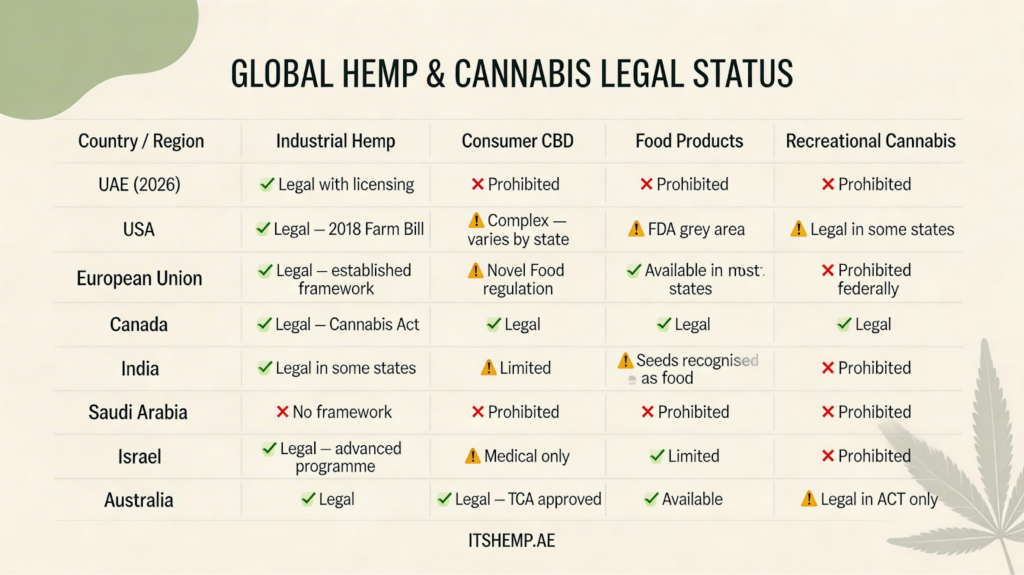
9h Where Is the UAE Headed?
Reading the trajectory of the UAE’s hemp regulatory journey, and comparing it with the trajectories of jurisdictions that have gone before, allows for some informed, if cautious, observations about where the UAE hemp story is likely to go.
The direction of travel is clearly towards greater openness, but the pace of that travel will be determined by factors that are not yet fully visible. The executive regulations still being developed throughout 2026 will set the practical parameters for the first generation of licensed hemp businesses. How those businesses perform, their compliance record, their economic contribution, and their public reception will significantly influence whether and how the regulatory framework evolves.
The experience of other jurisdictions suggests that successful industrial hemp frameworks tend to gradually expand their permitted categories over time, as public understanding matures, as enforcement capacity develops, and as the economic case for broader permission becomes more compelling. The EU’s journey from cautious cultivation permissions to a recognised consumer food market took years. India’s journey from NDPS restrictions to FSSAI food recognition took decades.
The UAE’s journey will be its own, shaped by its own values, its own economic priorities, and its own governance philosophy. What is certain is that the 2026 legalisation is a beginning, not a destination. The hemp story in the UAE has only just started.
Chapter 10: Frequently Asked Questions About Hemp Laws in the UAE
Throughout the process of researching and writing this guide, certain questions have come up repeatedly, from residents, expats, business owners, and travellers trying to make sense of the UAE’s new hemp framework. This chapter compiles the most important of those questions and answers them directly, clearly, and without ambiguity.
Is hemp legal in the UAE?
Industrial hemp, specifically Cannabis Sativa plants with 0.3% total THC or less, is legal in the UAE for licensed industrial and medical purposes under Federal Decree-Law No. 24 of 2025, which came into force on 1st January 2026. However, consumer hemp products, personal use of hemp, and recreational cannabis of any kind remain strictly prohibited. The legislation applies to licensed businesses operating in specific industrial and medical categories, not to individual consumers.
The answer depends entirely on what kind of CBD product you are asking about, and this distinction is one of the most important things any UAE resident or visitor needs to understand.
Consumer CBD oil, No.
CBD oil for personal use, whether purchased in a shop, ordered online, or brought from another country, is not legal in the UAE. This applies regardless of the concentration, regardless of the THC content, and regardless of where the product was purchased. Bringing consumer CBD products into the UAE carries real criminal risk.
Pharmaceutical CBD, A narrow exception exists.
The 2026 hemp law creates, for the first time, a legal pathway for CBD to be used as an ingredient in licensed pharmaceutical products in the UAE. A CBD-based medicine, formally approved through UAE pharmaceutical regulatory channels, prescribed by a licensed UAE physician for a specific medical condition, and dispensed through a licensed UAE pharmacy, is legally possible under the new framework.
These two categories are entirely separate. One is prohibited. The other represents a narrow, tightly regulated pharmaceutical pathway.
If you are asking whether you can buy CBD oil in a UAE shop, order it online, or bring it through Dubai airport, the answer is no. If you have a specific medical condition and believe a hemp-derived pharmaceutical may be relevant, consult a licensed UAE physician.
What hemp products can I legally buy in the UAE right now?
Hemp food products, with one important exception, hemp supplements, and consumer CBD products are not legally available for purchase in the UAE. The exception covers roasted or processed hemp seeds that have been rendered non-viable, which are permitted under Schedule No. 1 of the law, subject to specific conditions. For full details on this exception, see Chapter 5a of this guide.
Can I bring hemp products from my home country into the UAE?
No. There is no personal import pathway for hemp products under UAE law. It does not matter where the product was purchased, whether it is legal in your home country, what its THC content is, or how small the quantity is. Bringing consumer hemp or CBD products into the UAE, in your luggage, in a parcel, or by any other means, carries the risk of criminal charges, imprisonment, and deportation for foreign nationals. Do not do it.
Can I transit through an UAE airport with hemp products in my luggage?
No. UAE law applies to all persons and their belongings at UAE airports, including during transit. A passenger transiting through Dubai International Airport with CBD products in their luggage is subject to the UAE narcotics law during their time in that airport. The fact that you are in transit is not a legal defence. Remove any hemp or CBD products from your luggage before travelling through UAE airports.
Does the hemp law apply in the UAE free zones?
Yes. Federal Decree-Law No. 24 of 2025 explicitly states that it applies to all industrial hemp activities within the UAE, and this jurisdiction expressly includes free zones. Being located in a UAE free zone provides no exemption from licensing requirements, prohibited product categories, THC testing obligations, record-keeping requirements, or criminal penalties for violations.
Can I start a hemp business in the UAE?
Yes, in principle. Licensed industrial hemp businesses are now possible in the UAE for the first time. But the licensing process is complex, involving multiple federal and local authorities, and the compliance obligations are significant and ongoing. Before taking any steps towards establishing a hemp business in the UAE, engaging a UAE-qualified legal advisor with specific experience in hemp or pharmaceutical regulatory matters is absolutely essential. Do not proceed without specialist legal guidance.
What are the penalties for hemp law violations in the UAE?
Penalties range from administrative warnings and fines, from AED 10,000 to AED 1,000,000 for standard violations, and up to AED 2,000,000 for repeat violations, to criminal penalties including a minimum of three months imprisonment and a fine of at least AED 100,000 for serious breaches of the hemp law. Where a violation also constitutes a narcotics offence, the penalties of the narcotics law apply, including, in serious trafficking cases, life imprisonment. Foreign nationals face mandatory deportation after serving their sentence in most circumstances.
Is hemp seed oil legal in UAE cosmetics?
Yes. Pure hemp seed oil, derived from cold-pressing hemp seeds, containing no THC and no CBD, is permitted in cosmetic products in the UAE. This has been the case since January 2019 and is now codified in the 2026 hemp law. However, cosmetics containing hemp extract, cannabidiol, or any detectable THC remain prohibited. Always check the ingredient list carefully; hemp seed oil and hemp extract are legally distinct in the UAE.
Will hemp food products become legal in the UAE?
Hemp food products, seeds, protein, milk, and oil, are currently prohibited for consumer sale in the UAE, with one important exception: roasted or processed hemp seeds rendered non-viable are permitted under Schedule No. 1 of the law. However, the 2026 law includes a provision allowing the Cabinet to expand or modify the list of prohibited product categories by decision. This means there is a legal mechanism for future liberalisation of food and supplement categories. As of early 2026, there is no indication that such a Cabinet decision is imminent, but the pathway for future change exists within the framework.
Can hemp help with medical conditions in the UAE?
Under the 2026 law, hemp compounds can now be used as ingredients in licensed pharmaceutical products in the UAE, for the first time in the country’s history. This creates a pathway for specific hemp-derived medicines to be prescribed by licensed UAE physicians for patients with qualifying medical conditions. The most documented example globally is a CBD-based pharmaceutical for treatment-resistant epilepsy. However, as of early 2026, the specific pharmaceutical products available through UAE-licensed medical channels are still being determined through the regulatory approval process. If you have a medical condition for which you believe hemp-derived treatment may be relevant, consult a licensed UAE physician.
What should I do if I already have CBD products at home?
The legally safest course of action is to dispose of them properly. The 2026 hemp law created no amnesty period for pre-existing prohibited products. Possession of prohibited hemp-derived consumer products remains a violation of UAE law regardless of when they were purchased or where they came from. If you have specific concerns about your situation, seek advice from a qualified UAE legal professional.
How does the UAE hemp law compare to what I am used to in my home country?
This depends entirely on where you are from. If you are from Canada, the UK, or most of the United States, where consumer CBD products, hemp food products, and hemp supplements are widely available, the UAE’s current framework will feel significantly more restrictive. The consumer hemp market you are familiar with does not exist in the UAE. If you are from a country with stricter cannabis laws, such as much of Asia, the Middle East, and parts of Africa, the UAE’s new framework may actually represent a more progressive position than you are used to. The key is to understand the UAE’s framework on its own terms, not through the lens of wherever you have come from.
Is the UAE hemp regulatory landscape going to change?
Almost certainly, though the timeline and the direction of specific changes are not yet clear. Executive regulations, Cabinet decisions, and emirate-level implementing rules are being developed and published throughout 2026. The framework is explicitly designed with mechanisms for future expansion, including the Cabinet’s authority to add or remove prohibited product categories. The UAE’s track record as a first mover in emerging regulatory spaces and its stated commitment to aligning with international best practices suggest that the hemp framework will continue to evolve. ITSHEMP.AE is committed to keeping this guide updated as those changes occur.
Conclusion: What the UAE Hemp Law Actually Means
Federal Decree-Law No. 24 of 2025 is, without question, one of the most significant pieces of legislation in the UAE’s modern regulatory history.
For the first time, the country has separated industrial hemp from recreational cannabis, acknowledging what science has long established: that a plant containing 0.3% THC or less is fundamentally different, in every meaningful way, from the marijuana that the UAE’s narcotics laws were designed to control. That acknowledgement, codified in law and aligned with international standards, is genuinely historic.
But history and daily reality are different things. And for the vast majority of UAE residents, the millions of people going about their lives in Dubai, Abu Dhabi, Sharjah, and across the Emirates, the practical reality of the 2026 hemp law is more modest than the headlines suggest.
Hemp food products remain largely prohibited, with one narrow exception: roasted or processed hemp seeds that have been rendered non-viable are permitted under Schedule No. 1 of the law, subject to specific conditions. All other hemp food products, including raw seeds for consumption, hemp protein, hemp milk, and hemp-infused foods, remain prohibited.
What does exist, for the first time, is a foundation. A legal framework. A licensed pathway for industrial operators, agricultural businesses, pharmaceutical manufacturers, and medical professionals to begin building something new. The UAE has cleared the ground and laid the cornerstone. What gets built on that foundation will depend on the executive regulations still being written, the licensing decisions still being made, the emirate-level rules still being developed, and the businesses and investors who choose to engage with this market seriously and compliantly.
For residents, the message is clear: stay informed, stay compliant, and stay patient. The hemp landscape in the UAE is changing, but change of this kind takes time, and the consequences of getting ahead of the law are too serious to risk.
For businesses and entrepreneurs, the message is equally clear: the opportunity is real, the foundation is solid, and the UAE’s track record of building world-class regulated industries from scratch is genuinely encouraging. But this is a market that rewards patience, compliance, and specialist expertise, not enthusiasm alone.
A Final Note: Stay Updated
The regulatory landscape described in this guide reflects the state of UAE hemp law as of early 2026. Executive regulations, Cabinet decisions, and emirate-level implementing rules are being issued on an ongoing basis. Some details that are unclear today will be clarified in the coming months. Some categories that are currently prohibited may be opened. Some requirements that are currently general may become more specific.
ITSHEMP.AE is committed to keeping this guide updated as the regulatory landscape evolves. Bookmark this page, subscribe to our newsletter, and follow us for updates as they happen. For those reading this for the first time, ITSHEMP.AE is the UAE’s largest hemp and cannabis discovery and education platform, dedicated to providing clear, accurate, and up-to-date information on hemp laws, products, and industry developments across the Emirates.
Legal Disclaimer
The information contained in this article is provided for general informational and educational purposes only. It does not constitute legal advice and should not be relied upon as such.
UAE hemp law, including Federal Decree-Law No. 24 of 2025 and the broader narcotics framework, is a complex, evolving, and highly consequential area of law. The practical implications of this legislation differ significantly depending on your individual circumstances, your nationality, your business structure, and the specific activity you are considering.
The consequences of non-compliance in this area are severe, including criminal prosecution, substantial fines, imprisonment, and mandatory deportation for foreign nationals. These are not theoretical risks. They are real outcomes that have affected real people in the UAE.
Before making any decision, personal or commercial, that is informed by the contents of this article, you should seek independent legal advice from a qualified UAE lawyer with specific experience in hemp, pharmaceutical, or narcotics regulatory law.
ITSHEMP.AE makes every effort to ensure the accuracy and currency of the information published on this platform. However, laws and regulations change. Regulatory guidance evolves. Emirate-level rules are still being developed. No article, however thoroughly researched, can substitute for qualified legal counsel in your specific situation.
This article was last updated in early 2026. Readers should verify current regulatory requirements with qualified legal counsel before acting on any information contained herein.
Leave a Reply