
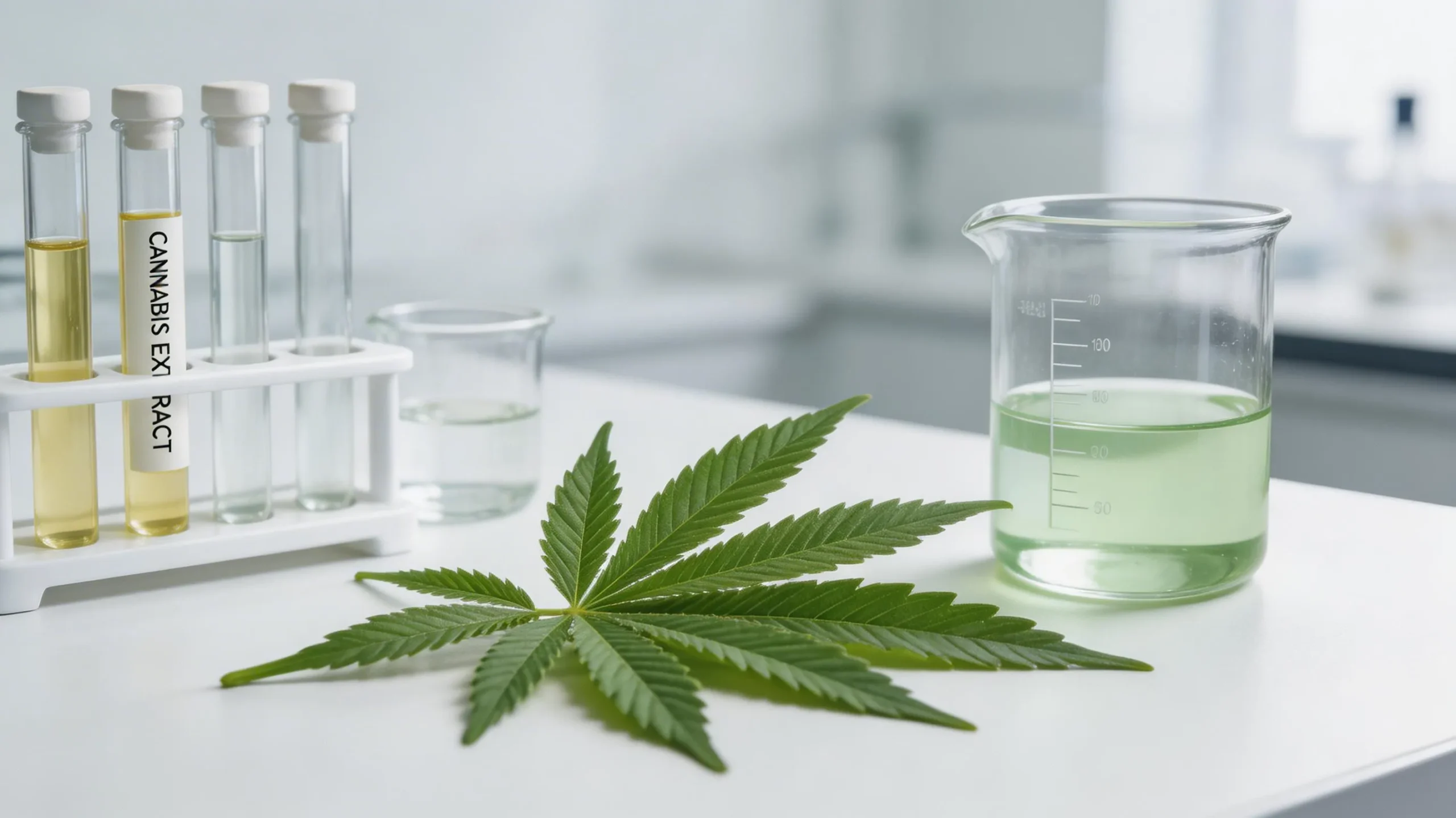
The UAE now has a legal framework for industrial hemp, but every legal hemp product must stay within one strict limit: 0.3% total THC on a dry-weight basis.
That number is the legal boundary between industrial hemp and cannabis that may fall under the UAE’s narcotics framework. For businesses, importers, manufacturers, and anyone trying to understand hemp compliance in the UAE, this is the most important rule to get right.
The Short Answer
Under Federal Decree-Law No. 24 of 2025, industrial hemp in the UAE must not exceed 0.3% total THC in the flowering heads and leaves of the plant, measured on a dry-weight basis.
The important detail is that the UAE does not look only at delta-9 THC. It uses total THC, which means the calculation must also consider the potential conversion of THCa into delta-9 THC. This makes the UAE standard stricter than simple delta-9-only testing.
In practical terms: a product may look compliant in another country but still fail UAE requirements if its total THC exceeds 0.3%.
What Is THC?
THC stands for tetrahydrocannabinol. It is the main psychoactive compound found in cannabis.
When people talk about cannabis causing a “high,” they are usually talking about the effect of THC, especially delta-9 THC. Industrial hemp contains much lower THC levels than high-THC cannabis, which is why many countries use a THC threshold to separate hemp from narcotic cannabis.
In the UAE, that threshold is 0.3% total THC.
What Is the THC Limit for Hemp Products in the UAE?
The THC limit UAE hemp products must follow is 0.3% total THC on a dry-weight basis.
Federal Decree-Law No. 24 of 2025 defines industrial hemp as Cannabis sativa, or any part, derivative, or extract of it, where the total concentration of tetrahydrocannabinol does not exceed 0.3% in the flowering heads and leaves.
The law also says that the calculation must take into account the possible conversion of THCa into delta-9 THC.
That means UAE compliance is not simply about checking one THC number on a foreign certificate. The certificate must reflect the UAE’s total THC approach.
Total THC vs Delta-9 THC: Why the Difference Matters
This is where many hemp businesses can get confused.
Delta-9 THC
Delta-9 THC is the active psychoactive form of THC. Many older hemp testing systems focused mainly on delta-9 THC.
THCa
THCa is the acidic precursor to delta-9 THC. It is found naturally in raw cannabis and hemp plants. THCa itself is not the same as active delta-9 THC, but it can convert into delta-9 THC when exposed to heat through a process called decarboxylation.
Total THC
Total THC looks at both:
- The delta-9 THC already present
- The potential delta-9 THC that could come from THCa conversion
A commonly used calculation is:
Total THC = Delta-9 THC + (THCa × 0.877)
The UAE decree confirms that THCa conversion must be considered, while the detailed analysis and calculation mechanism is to be specified in the Executive Regulations.
Simple Example: How a Product Can Fail the UAE THC Limit
Imagine a hemp raw material has:
| Compound | Test Result |
|---|---|
| Delta-9 THC | 0.15% |
| THCa | 0.20% |
Under a delta-9-only system, this may appear compliant because delta-9 THC is below 0.3%.
But under a total THC approach:
Total THC = 0.15 + (0.20 × 0.877)
Total THC = 0.325%
That result is above 0.3%, which means the material would not meet the UAE industrial hemp threshold.
This is why businesses should not rely on a foreign certificate unless it clearly confirms total THC in a way that matches UAE requirements.
Does the 0.3% Limit Apply to Every Hemp Product?
The 0.3% rule is the core definition for industrial hemp, but it does not mean every product containing hemp is automatically allowed in the UAE.
Federal Decree-Law No. 24 of 2025 allows regulated industrial hemp activity only within licensed categories. It also prohibits importing or manufacturing certain hemp product types.
Products That Need Careful Legal Review
| Product Type | UAE Position |
|---|---|
| Industrial hemp raw materials | May be allowed under licence if compliant |
| Hemp fibre, textiles, construction materials, and industrial products | Expected to fall under permitted industrial uses, subject to executive regulations and licensing |
| Hemp products for import/export | Require permits, approvals, and certificates |
| Hemp food products | Prohibited, except limited non-viable processed seed exception |
| Hemp food supplements | Prohibited |
| Smoking products | Prohibited |
| Veterinary products | Prohibited |
| Cosmetics | Only narrow categories may qualify, and they must meet strict THC-free conditions |
For cosmetics, the law is stricter than the general 0.3% industrial hemp threshold. It refers to cosmetics containing oils from industrial hemp seeds or stems and requires them to be free from THC in all forms and precursor acids, along with other cannabis-derived compounds that may produce a narcotic effect.
So, a cosmetic product with detectable CBD, THC, cannabis extract, resin, or flowering-top extract should not be assumed legal simply because it is below 0.3%.
Who Tests Hemp Products in the UAE?
For hemp product imports and exports, the UAE decree requires certificates from laboratories accredited by the Ministry of Industry and Advanced Technology, confirming that THC concentration does not exceed 0.3%.
For manufacturing, licensed establishments must have an internal laboratory or proof of a contract with an external laboratory accredited in the UAE. Manufacturers must conduct periodic tests on raw materials and final products and submit reports to the relevant authorities.
This means THC testing is not a one-time formality. It is part of the operating system for any licensed hemp business in the UAE.
When Is THC Testing Required?
Testing depends on the activity.
For Cultivators
Licensed cultivators must conduct periodic tests during the production chain, from cultivation to post-harvest, to ensure THC does not exceed 0.3%.
The exact number of samples and testing schedule will be specified by the Executive Regulations.
For Manufacturers
Manufacturers must test:
- Raw materials
- Final products
They must also submit periodic reports to the Licensing Authority and the Ministry of Industry and Advanced Technology.
For Importers
Every consignment of industrial hemp products intended for import must have a certificate from laboratories accredited by the Ministry of Industry and Advanced Technology confirming THC does not exceed 0.3%.
The import permit process also requires other documents, including product labels, certificate of origin, insurance, valid contract, and relevant approvals.
For Exporters
Every export consignment must also have a certificate from MoIAT-accredited laboratories confirming THC does not exceed 0.3%.
Exporters must also provide approval from the competent government authority in the destination country confirming the products can be imported there.
Why Foreign Certificates May Not Be Enough
A foreign certificate can be useful, but it should not be treated as automatic UAE compliance.
There are three reasons:
- The foreign certificate may measure only delta-9 THC, not total THC.
- The foreign country may use a different THC limit.
- The laboratory may not meet the accreditation requirement expected under UAE law.
For UAE compliance, the certificate must match the UAE framework. For import and export, the decree specifically requires certificates from laboratories accredited by the Ministry of Industry and Advanced Technology.
What Happens If Hemp Exceeds 0.3% THC?
If THC exceeds the permitted percentage, the product is no longer safely within the industrial hemp definition.
For cultivation, the licensee must notify:
- The Ministry of Climate Change and Environment
- The concerned Local Authority
- The National Anti-Narcotics Authority
For manufacturing, the licensee must notify the Licensing Authority and the National Anti-Narcotics Authority if products exceed 0.3%.
The decree also allows seizure of industrial hemp seeds, seedlings, or products where THC concentration exceeds the permitted percentage.
This is why an exceedance should not be treated as a normal quality-control issue. In the UAE, it can become a serious legal and regulatory event.
Penalties for Exceeding or Misusing the THC Limit
Federal Decree-Law No. 24 of 2025 includes administrative sanctions and criminal penalties.
Administrative sanctions may include:
- Warning
- Administrative fines from AED 10,000 to AED 1,000,000
- Doubled fines for repeat violations, up to AED 2,000,000
- Temporary suspension of licences, approvals, or permits
- Revocation of licences, approvals, or permits
The law also provides criminal penalties for certain violations. These include a minimum of three months’ imprisonment and a fine of at least AED 100,000, or either penalty, for acts such as:
- Conducting regulated hemp activities without a licence
- Importing, exporting, or circulating hemp products outside permitted purposes
- Possessing or acquiring industrial hemp products without the required licence
- Using materials that may increase THC concentration above 0.3%
- Failing to report when THC exceeds 0.3%
The decree’s penalty section provides imprisonment of not less than three months and a fine of not less than AED 100,000, or either penalty, for several listed hemp-law violations, including failure to report THC exceedance.
UAE THC Limit Compared With Other Countries
Many hemp markets use a 0.3% THC threshold, but the details vary by country. Some jurisdictions use total THC. Some focus on delta-9 THC. Some apply different rules for cultivation, finished products, cosmetics, foods, or supplements.
That difference matters for UAE importers.
A product that is compliant in its country of origin may still fail UAE requirements if:
- Its total THC exceeds 0.3%
- Its certificate does not account for THCa conversion
- It belongs to a prohibited product category in the UAE
- It lacks the required UAE-recognised testing and permits
Key Compliance Checklist for UAE Hemp Products
Before importing, manufacturing, exporting, or circulating a hemp product in the UAE, check the following:
| Compliance Question | Why It Matters |
|---|---|
| Is the product category allowed? | Some hemp foods, supplements, smoking products, veterinary products, and many cosmetics are prohibited. |
| Is the product within 0.3% total THC? | This is the legal hemp threshold. |
| Does the test include THCa conversion? | UAE law requires total THC, not delta-9 only. |
| Is the certificate from the correct accredited laboratory? | Import/export certificates must come from MoIAT-accredited labs. |
| Is the business licensed? | Possession, import, export, manufacturing, and circulation are regulated activities. |
| Are permits and local approvals in place? | Federal and emirate-level requirements may apply. |
| Are records maintained? | Licensees must keep organised records for at least five years. |
What This Means for Businesses
The 0.3% THC rule is positive because it gives industrial hemp a defined legal pathway in the UAE. But that pathway is narrow and highly regulated.
For businesses, the main lesson is this: the UAE hemp market is not a casual import market. It is a licensed, tested, documented, and authority-supervised framework.
Any business working with hemp should build compliance into the operation from the beginning. That means checking product category, licence status, local emirate requirements, testing methodology, certificate wording, lab accreditation, labelling, tracking, and record-keeping before the product enters the supply chain.
Conclusion
The UAE THC limit for hemp products is 0.3% total THC on a dry-weight basis. This limit includes the potential conversion of THCa into delta-9 THC, which makes total THC testing essential.
Below the limit, a product may qualify as industrial hemp if all other licensing, product-category, testing, permit, and documentation requirements are met. Above the limit, the product may fall outside the industrial hemp framework and trigger serious legal consequences.
For importers, manufacturers, exporters, and hemp businesses, the 0.3% rule should be treated as a core compliance requirement, not a technical detail. In the UAE, legal hemp starts with the THC number, but it does not end there.
Legal Disclaimer
This article is for informational purposes only and does not constitute legal advice. UAE hemp law is complex and continues to depend on executive regulations, Cabinet decisions, federal authority procedures, and emirate-level implementation. Before importing, manufacturing, selling, exporting, or possessing any hemp-related product in the UAE, consult a qualified UAE legal professional and verify current requirements with the relevant authorities.
What is the THC limit for hemp products in the UAE?
The UAE THC limit for hemp products is 0.3% total THC on a dry-weight basis. The limit applies to the industrial hemp definition under Federal Decree-Law No. 24 of 2025.
Does the UAE measure total THC or delta-9 THC?
The UAE measures total THC. This includes delta-9 THC and the potential conversion of THCa into delta-9 THC.
Can a product below 0.3% THC still be illegal in the UAE?
Yes. A product can be below 0.3% THC but still be prohibited if it falls into a banned category, such as hemp supplements, smoking products, veterinary products, or non-compliant cosmetics.
Are hemp cosmetics allowed in the UAE?
Only limited hemp cosmetics may qualify, mainly those containing oils extracted from hemp seeds or stems and meeting strict THC-free and non-narcotic-effect conditions. CBD cosmetics or hemp extract cosmetics should not be assumed legal.
Can I import hemp products into the UAE with a foreign lab certificate?
A foreign certificate alone should not be treated as enough. UAE import compliance requires a certificate from laboratories accredited by the Ministry of Industry and Advanced Technology confirming THC does not exceed 0.3% for the consignment.
What happens if hemp exceeds 0.3% THC in the UAE?
The exceedance must be reported to the relevant authorities, and the product may be seized. Certain violations can also lead to criminal penalties, including imprisonment and fines.
External Source
https://uaelegislation.gov.ae/en/legislations/3886/download
Leave a Reply