
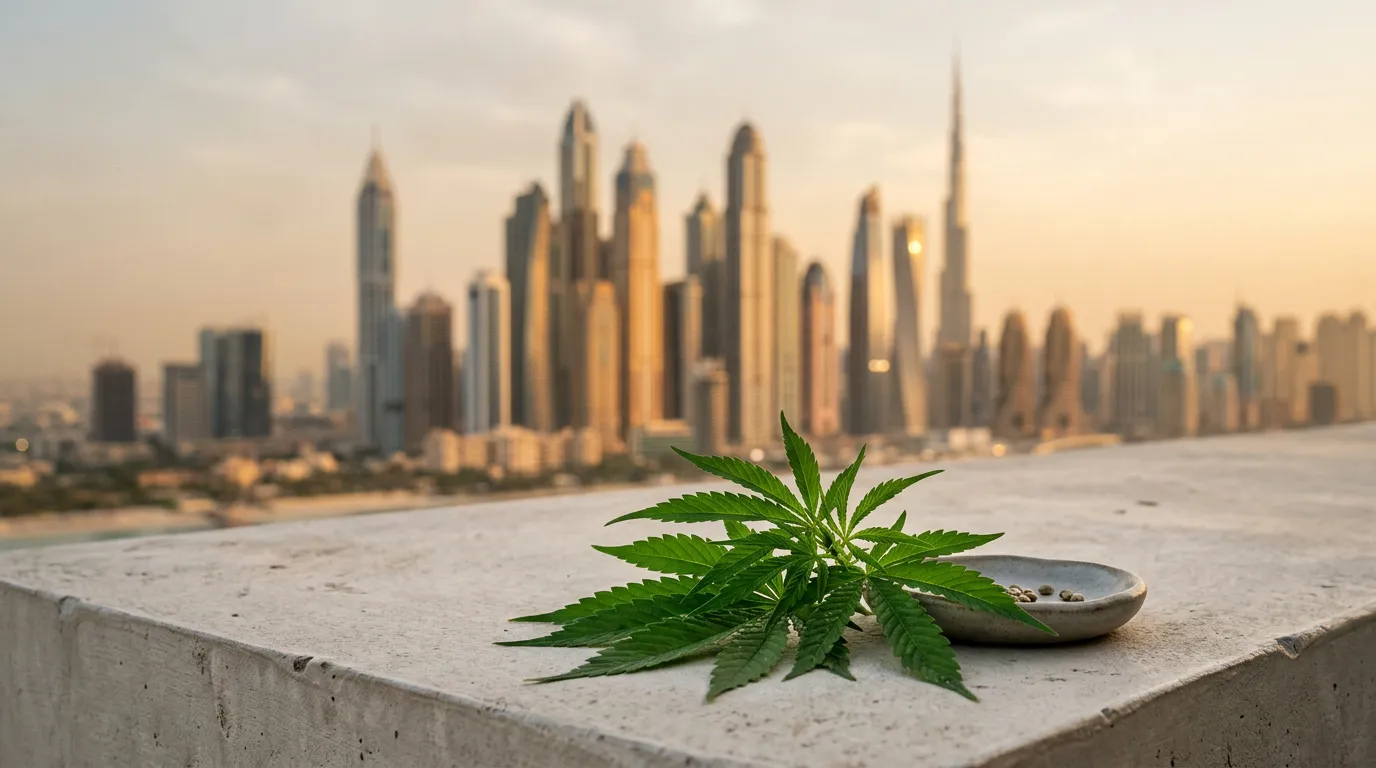
The Gulf is entering a new phase of hemp regulation, and the UAE is leading that shift.
For the first time in the GCC, industrial hemp is no longer being treated only through the old lens of cannabis prohibition. With Federal Decree-Law No. 24 of 2025 coming into force on 1 January 2026, the UAE has created a controlled legal pathway for licensed industrial and medical hemp activity.
That is a major development for the region. It shows that hemp can be regulated carefully, separated from recreational cannabis, and used for specific industrial, commercial, and medical purposes under strict government supervision.
But this progress is not GCC-wide yet.
Saudi Arabia, Bahrain, Kuwait, Qatar, and Oman have not introduced similar hemp laws. In those countries, cannabis-related substances remain controlled under strict narcotics frameworks, with no comparable legal pathway for industrial hemp, consumer CBD, or hemp-based products.
This hemp law GCC comparison explains where each Gulf country stands, why the UAE is different, and what residents, travellers, investors, and businesses need to understand before making any decision involving hemp in the GCC.
Which GCC Country Allows Hemp?
The UAE is currently the only GCC country with a dedicated industrial hemp law.
Federal Decree-Law No. 24 of 2025, effective from 1 January 2026, creates a licensed framework for industrial hemp activities in the UAE, including cultivation, manufacturing, import, export, and circulation of approved industrial hemp products.
However, the UAE framework is not a free consumer hemp market. Food supplements, smoking products, veterinary products, and most hemp food products remain prohibited. Medical products containing industrial hemp compounds are handled through the UAE’s medical products framework, not ordinary retail sale.
In the rest of the GCC, Saudi Arabia, Bahrain, Kuwait, Qatar, and Oman do not currently have a comparable industrial hemp framework.
GCC Hemp Law Comparison Table
| GCC Country | Industrial Hemp Law | 0.3% THC Hemp Threshold | Consumer CBD | Hemp Food/Supplements | Licensed Business Pathway | Overall Position |
|---|---|---|---|---|---|---|
| UAE | Yes | Yes | No general consumer CBD | Mostly prohibited | Yes, under licence | Most advanced in GCC |
| Saudi Arabia | No | No | Prohibited | Prohibited | No | Strict narcotics framework |
| Bahrain | No | No | Prohibited | Prohibited | No | CBD and marijuana prohibited for import |
| Kuwait | No | No | Prohibited | Prohibited | No | Strict anti-drug framework |
| Qatar | No | No | Prohibited | Prohibited | No | Strict narcotics framework |
| Oman | No | No | Prohibited | Prohibited | No | Controlled substances tightly regulated |
What Makes UAE Hemp Law Different?
The UAE is the first GCC country to legally separate low-THC industrial hemp from higher-THC cannabis for specific licensed uses.
Under Federal Decree-Law No. 24 of 2025, industrial hemp is defined as Cannabis Sativa, including its parts, derivatives, or extracts, where total THC in the flowering heads and leaves does not exceed 0.3% on a dry-weight basis. The law also counts the potential conversion of THCa into delta-9 THC when calculating total THC.
This matters because the UAE has created a legal distinction that other GCC countries have not yet adopted. In most of the GCC, hemp is not separately treated as an industrial crop. It remains grouped within broader cannabis or narcotics control systems.
What Is Allowed Under the UAE Hemp Framework?
The UAE law creates a licensed pathway for specific industrial hemp activities, including:
- Import and export of industrial hemp seeds
- Cultivation of industrial hemp
- Transport of industrial hemp seeds and seedlings
- Manufacturing of approved industrial hemp products
- Import and export of approved industrial hemp products
- Commercial circulation of approved products
- Medical products containing industrial hemp compounds, under the UAE medical products framework
This is a business and regulatory framework. It is not permission for individuals to freely buy, carry, grow, or use hemp products.
What Is Still Restricted in the UAE?
The UAE’s hemp law is carefully limited. It does not legalise recreational cannabis. It does not create an open CBD wellness market. It does not allow ordinary consumers to treat hemp products casually.
The law prohibits the import or manufacture of several categories of industrial hemp products, including:
- Food products, except limited processed non-viable hemp seed exceptions
- Food supplements
- Veterinary products
- Smoking products
- Cosmetic products, except narrow categories involving oils from seeds or stems and subject to strict conditions
- Any other products later restricted by Cabinet decision
This is one of the most important points for readers to understand. The UAE is more advanced than the rest of the GCC on industrial hemp, but it remains highly controlled.
Saudi Arabia Hemp Law: Strict Prohibition, No Hemp Framework
Saudi Arabia does not currently have a dedicated industrial hemp law. There is no formal 0.3% THC distinction, no licensed industrial hemp cultivation pathway, and no general CBD pathway.
Cannabis-related substances remain regulated under Saudi Arabia’s narcotics framework. Saudi authorities treat narcotics offences seriously. Saudi MOI states that narcotics users may face jail and that foreign offenders may be deported. It also states that repeat narcotics dealers may face increased punishment, including the possibility of the death penalty.
For travellers, this means a product purchased legally in the UAE should not be assumed legal in Saudi Arabia. This includes CBD oil, hemp supplements, hemp extracts, and other cannabis-derived products.
Saudi Arabia may be worth watching in the long term because of its industrial diversification and sustainability agenda. But as of now, there is no official Saudi hemp framework.
Bahrain Hemp Law: No Industrial Hemp Pathway
Bahrain does not currently have a dedicated industrial hemp law. Cannabis-derived products remain controlled, and CBD is not treated as an ordinary consumer product.
Bahrain customs guidance listed by the U.S. International Trade Administration states that prohibited imports include “all types of narcotic drugs,” specifically naming marijuana and CBD oil.
This makes Bahrain very different from the UAE. A hemp or CBD product that may be discussed under the UAE’s licensed framework should not be carried into Bahrain without specific legal clearance.
Bahrain may be relevant in the future as a financial, trade, or regulatory services hub, but there is no clear near-term legal pathway for hemp businesses.
Kuwait Hemp Law: Strict Anti-Drug Framework
Kuwait does not currently have a dedicated industrial hemp framework.
In December 2025, Kuwait’s Decree-Law No. 159/2025 on combating narcotic drugs and dangerous psychotropic substances took effect. The law unified Kuwait’s anti-drug framework and maintains comprehensive controls over narcotic and psychotropic substances.
The framework includes broad prohibitions on activities such as production, manufacture, import, export, possession, purchase, sale, trade, prescribing, consumption, and transport of scheduled narcotic or psychotropic substances, except where legally permitted.
For hemp businesses, Kuwait is not a viable near-term market unless and until a separate hemp framework is introduced. For travellers, the safest approach is not to carry hemp, CBD, or cannabis-derived products into Kuwait.
Qatar Hemp Law: No Hemp Exception
Qatar does not currently have a dedicated industrial hemp framework or a general CBD pathway.
Qatar’s Ministry of Interior states that drug and psychotropic substance crimes are governed by Law No. 9 of 1987 and its amendment, Law No. 7 of 1998. Qatar maintains strict controls, with severe penalties for serious drug-related offences.
Qatar’s customs system also lists Cannabis Sativa among prohibited tariff goods, which reinforces the practical risk for anyone carrying hemp or cannabis-related products.
For residents, visitors, and transit passengers, Qatar should be treated as a strict jurisdiction for hemp and CBD products.
Oman Hemp Law: Controlled Substances Remain Strictly Regulated
Oman does not currently have a dedicated industrial hemp law or an ordinary CBD pathway.
Oman’s Ministry of Health guidance on travelling with medicines explains that controlled substances listed under Oman’s narcotics and psychotropic control framework require documentation such as certified medical reports or prescriptions, and personal-use quantities are tightly limited.
This guidance is mainly about medicines, but it shows Oman’s careful approach to controlled substances. Hemp, CBD, and cannabis-derived products should not be carried into Oman unless their legal status has been checked with qualified local counsel and the relevant authority.
Oman may be interesting in the long term because of its agricultural diversification goals and varied geography, but there is no current hemp business pathway comparable to the UAE.
Why the UAE Is the GCC Outlier
The UAE’s position is different for four main reasons.
First, it has created a legal definition of industrial hemp based on a 0.3% total THC threshold.
Second, it has built a licensing structure involving federal and local authorities, including agriculture, industry, trade, customs, health, and security-related bodies.
Third, it has created a controlled pathway for industrial and medical uses while keeping recreational cannabis and consumer CBD restricted.
Fourth, it has the business infrastructure to support a regulated sector, including free zones, ports, logistics systems, accredited laboratories, legal services, and international trade networks.
This does not mean the UAE is a mature hemp market yet. It means the UAE is the first GCC country to create the legal foundation for one.
What This Means for Travellers and Residents
The most important rule for travellers is simple: hemp legality does not travel with the product.
A product that is legal, licensed, or tolerated in one country may be illegal in another. This is especially important in the GCC, where people often move between Dubai, Abu Dhabi, Riyadh, Doha, Manama, Muscat, and Kuwait City for work, tourism, or family reasons.
Do not carry CBD oil, hemp supplements, hemp gummies, hemp extracts, cannabis cosmetics, or hemp food products across GCC borders unless you have verified the product’s status in the destination country.
Even in the UAE, the legal framework is not a casual consumer permission system. It is a licensed industrial and medical framework with restrictions.
What This Means for Hemp Businesses
For businesses, the GCC map is clear: the UAE is currently the only serious entry point.
A hemp business cannot treat the GCC as one unified legal market. The UAE may allow specific licensed activities, but Saudi Arabia, Bahrain, Kuwait, Qatar, and Oman do not currently offer comparable pathways.
This makes the UAE strategically important. A company that establishes a compliant UAE operation could be better positioned if neighbouring GCC countries eventually develop their own hemp frameworks. But expansion into those countries should be treated as a long-term possibility, not a current business plan.
The most realistic UAE opportunities are likely to be:
- Industrial hemp product trading
- Textiles and fibre-based applications
- Construction and building materials
- Paper and packaging
- Licensed medical product supply chains
- Regulatory, testing, and compliance services
Consumer CBD, hemp supplements, smoking products, and ordinary ingestible hemp products remain high-risk and restricted.
Is the GCC Likely to Follow the UAE?
It is possible that other GCC countries may eventually study the UAE model, especially if the UAE demonstrates that industrial hemp can be regulated safely and commercially.
However, no other GCC country has announced a comparable hemp framework as of 2026. Any future change would likely begin with industrial uses, not consumer cannabis or CBD wellness products.
The most likely future path, if change happens, would be:
- Industrial uses first, such as textiles, construction, and packaging.
- Strict licensing and security controls.
- No recreational cannabis market.
- Limited or medical-only cannabinoid use, if permitted at all.
- Gradual country-by-country regulation, not GCC-wide legalisation.
Conclusion
The UAE is currently the only GCC country with a dedicated industrial hemp law. That makes it the region’s first legal platform for licensed hemp activity.
But the rest of the GCC has not followed. Saudi Arabia, Bahrain, Kuwait, Qatar, and Oman continue to regulate cannabis-related substances through strict narcotics frameworks, with no clear industrial hemp carve-out.
For travellers, the safest rule is to avoid carrying hemp or CBD products across GCC borders. For businesses, the UAE is the only practical starting point for a compliant GCC hemp strategy.
The GCC hemp story has begun, but for now, it begins in the UAE.
Is hemp legal in the GCC?
Hemp is not broadly legal across the GCC. The UAE is currently the only GCC country with a dedicated industrial hemp framework. Saudi Arabia, Bahrain, Kuwait, Qatar, and Oman do not currently have comparable industrial hemp laws.
Which GCC country has the most progressive hemp law?
The UAE has the most advanced hemp law in the GCC. Federal Decree-Law No. 24 of 2025 creates a licensed framework for industrial and medical uses of industrial hemp.
Is CBD legal in the GCC?
Consumer CBD is not broadly legal in the GCC. In the UAE, medical products containing industrial hemp compounds may be handled through the regulated medical products framework, but ordinary consumer CBD remains restricted. In Saudi Arabia, Bahrain, Kuwait, Qatar, and Oman, CBD should be treated as prohibited unless official legal guidance says otherwise.
Is hemp legal in Saudi Arabia?
No dedicated industrial hemp framework currently exists in Saudi Arabia. Cannabis-related substances remain controlled under Saudi narcotics law.
Can I take hemp products from Dubai to Saudi Arabia
No. Do not assume a product purchased or discussed legally in the UAE is legal in Saudi Arabia. Carrying hemp, CBD, or cannabis-derived products across the UAE-Saudi border can create serious legal risk.
Is hemp legal in Bahrain?
Bahrain does not currently have a dedicated industrial hemp framework. Import guidance specifically lists marijuana and CBD oil among prohibited narcotic drugs.
Is hemp legal in Qatar?
Qatar does not currently have a dedicated industrial hemp framework. Qatar maintains strict controls on narcotic drugs and psychotropic substances.
Is hemp legal in Oman?
Oman does not currently have a dedicated industrial hemp framework. Controlled substances are tightly regulated, especially for travellers carrying medicines.
Is hemp legal in Kuwait?
Kuwait does not currently have a dedicated industrial hemp framework. Its anti-drug framework remains strict and comprehensive.
Is the UAE hemp law the same as cannabis legalisation?
No. The UAE hemp law is not recreational cannabis legalisation. It is a controlled framework for licensed industrial and medical uses of low-THC industrial hemp.
External Source
https://uaelegislation.gov.ae/en
https://www.trade.gov/bahrain-country-commercial-guide
https://www.moh.gov.om/en/media-center/news/medications-travel
Leave a Reply