
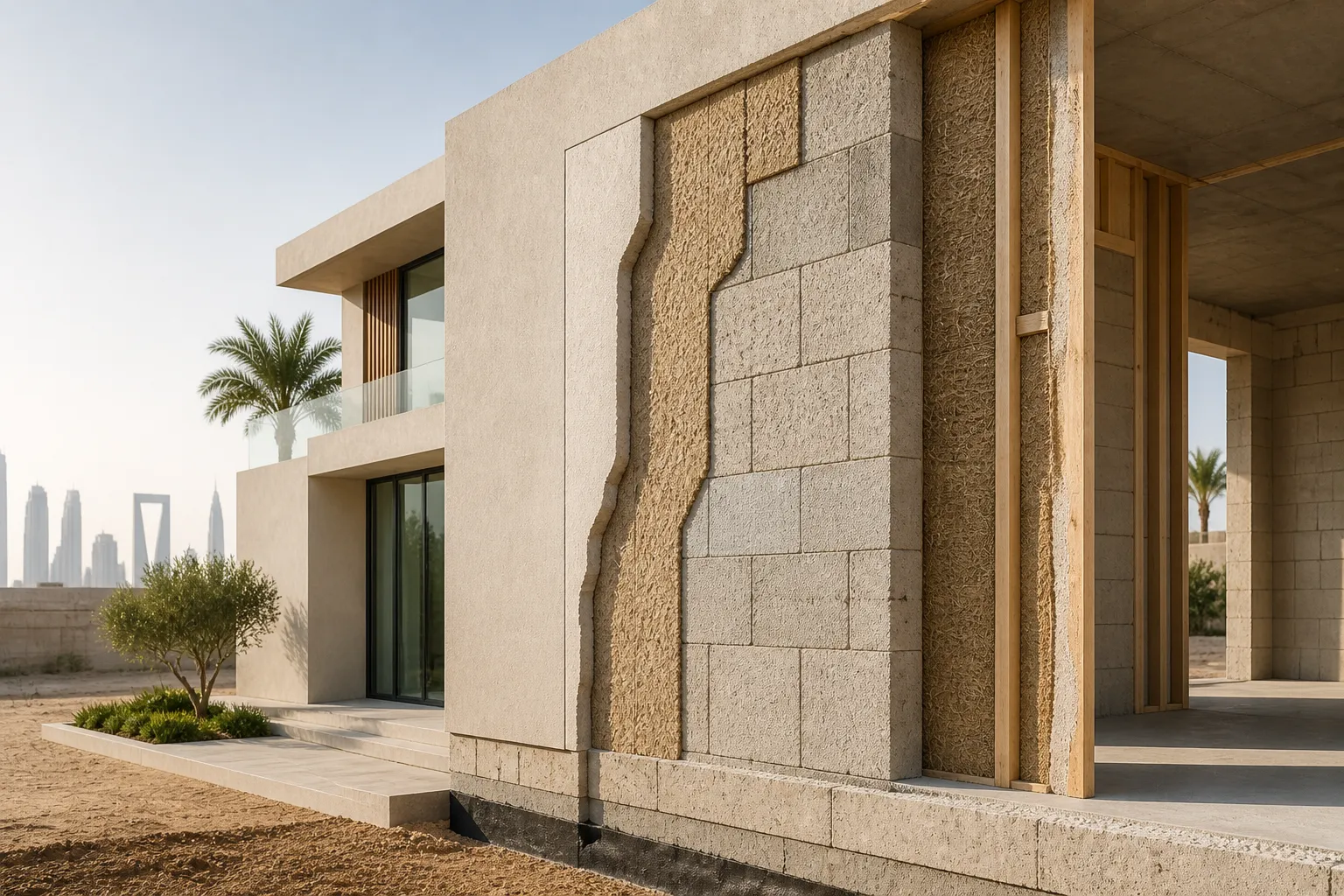
The UAE is one of the most active construction markets in the world. It is also a country where building materials are now being judged not only by strength, cost, and finish, but also by energy performance, embodied carbon, indoor air quality, and long-term sustainability.
That is why hempcrete and hemp insulation are starting to attract attention.
But in the UAE, the first question is not simply whether hemp building materials perform well. The first question is legal: can hemp-derived construction materials be manufactured, imported, traded, or used in UAE construction projects?
The Short Answer
Hemp building materials in the UAE may be used only within the country’s regulated industrial hemp framework. Federal Decree-Law No. 24 of 2025, effective from 1 January 2026, created a legal framework for industrial and medical uses of industrial hemp. It allows licensed activities such as manufacturing, importing, exporting, and circulating industrial hemp products, subject to approvals, THC compliance, documentation, and future executive regulations.
That means hempcrete, hemp fibre insulation, hemp panels, and similar construction materials should not be treated like ordinary consumer products. They are industrial materials that require the right licences, import permits, lab certificates, and local approvals before they can be commercially manufactured, imported, or supplied in the UAE.
The safest answer is this:
Hempcrete and hemp insulation can fit within the UAE’s industrial hemp framework, but only when handled by licensed businesses and supported by proper compliance documentation.
Hemp Building Materials UAE: Legal Status at a Glance
| Product or activity | UAE position | What to check |
|---|---|---|
| Hempcrete blocks or cast hempcrete | Potentially permitted under the industrial hemp framework | Product classification, licensed supplier, THC certificate, building approval |
| Hemp fibre insulation | Potentially permitted as an industrial hemp construction product | Import/manufacturing licence, lab certificate, fire/thermal performance data |
| Importing hemp construction materials | Regulated | Import permit, commercial registration, certificate of origin, MoIAT-accredited THC certificate |
| Manufacturing hemp products in the UAE | Regulated | Local authority licence, MoIAT approval, quality system, accredited lab access |
| Selling or distributing hemp products commercially | Regulated | Licence, product labelling, advertising approval where applicable |
| Hemp food, supplements, smoking products | Prohibited categories under the decree | Do not confuse construction materials with consumer hemp products |
This distinction matters. The UAE’s hemp framework is not a general approval for all hemp products. The decree specifically prohibits certain categories, including food products in UAE, food supplements in UAE, veterinary products, smoking products, and most cosmetic products unless they meet narrow exceptions.
What Is Hempcrete?
Hempcrete is a bio-based building material made by mixing the woody inner core of the hemp stalk, usually called hemp hurd or hemp shiv, with a lime-based binder and water.
Despite the name, hempcrete is not the same as concrete. It is not designed to replace reinforced concrete, steel, or structural masonry. Hempcrete is usually used as an insulating wall material around a structural frame.
A simple way to understand it:
Concrete carries the building. Hempcrete helps form the building envelope.
In most projects, the load is carried by timber, steel, reinforced concrete, or another structural system. Hempcrete is then cast, sprayed, or installed as blocks around that frame to improve insulation, moisture regulation, thermal comfort, and embodied carbon performance.
Is Hempcrete Stronger Than Concrete?
No. Hempcrete is not stronger than concrete.
This is one of the most important points for UAE architects, engineers, and developers. Hempcrete has low compressive strength compared with conventional concrete. It should not be specified as a load-bearing replacement for structural concrete unless it is part of a tested and engineered system approved for that use.
Its value is different. Hempcrete is used for:
- Thermal insulation
- Wall infill
- Moisture buffering
- Acoustic comfort
- Lower embodied carbon
- Better indoor environmental quality
For UAE projects, this makes hempcrete more relevant to the building envelope than to the structural frame.
What Is Hemp Insulation?
Hemp insulation is different from hempcrete.
Hemp fibre insulation is usually made from processed hemp fibres formed into batts, rolls, boards, or loose-fill insulation. It works more like mineral wool, fibreglass, or other insulation materials. It can be used between studs, above ceilings, under floors, or within wall systems, depending on the product specification and project approval.
Compared with hempcrete, hemp insulation is often easier to integrate into conventional construction because it does not require the same casting, curing, or specialist installation process.
Hempcrete vs Hemp Insulation
| Feature | Hempcrete | Hemp fibre insulation |
|---|---|---|
| Main material | Hemp hurd/shiv + lime binder | Processed hemp fibre |
| Main use | Wall infill and insulating envelope | Thermal/acoustic insulation |
| Structural role | Non-load-bearing in standard use | Non-structural |
| Installation | Cast-in-place, sprayed, or blocks | Batts, boards, rolls, or loose fill |
| Key benefit | Thermal mass + moisture regulation | Easier fit into standard wall/roof systems |
| UAE relevance | Useful for sustainable building envelopes | Useful for insulation upgrades and new builds |
Both materials are construction-focused uses of industrial hemp. Both should be treated as regulated industrial products, not casual consumer goods.
What UAE Law Says About Industrial Hemp
Federal Decree-Law No. 24 of 2025 defines industrial hemp as cannabis sativa, or parts, derivatives, or extracts of the plant, where the total THC concentration in flowering heads and leaves does not exceed 0.3% on a dry-weight basis. The calculation must also account for the potential conversion of THCa into delta-9 THC.
The law covers industrial hemp activities in the UAE, including free zones. These activities include:
- Import and export of industrial hemp seeds
- Cultivation of industrial hemp
- Transport of seeds and seedlings
- Manufacturing of industrial hemp products
- Import and export of industrial hemp products
- Circulation of industrial hemp products
However, the law is licence-based. It is not a free market where any company can import or sell hemp materials without approval.
Article 4 states that activities requiring a licence cannot be practised unless the relevant licence has been obtained from the competent licensing authority.
What This Means for Hemp Building Materials in UAE
For hemp building materials UAE suppliers, the key point is simple: legality depends on compliance.
A hempcrete block, hemp insulation board, or hemp fibre construction panel may be commercially viable only if it is handled through the correct industrial hemp channels. That may include:
- A licensed UAE importer or manufacturer
- Product classification under permitted industrial hemp uses
- THC compliance documentation
- Certificates from accredited laboratories
- Certificate of origin
- Valid commercial registration
- Import permit where required
- Local authority approvals
- Building-code and civil-defence compliance where relevant
The decree also states that executive regulations will specify the sectors, industries, and fields in which industrial hemp use is permitted. Legal commentary on the decree identifies construction materials as one of the industrial sectors expected to benefit from the framework, alongside textiles, paper, packaging, and pharmaceuticals.
Because of this, the strongest wording is not “anyone can use hempcrete freely.” The stronger and more accurate wording is:
Hemp construction materials can be developed in the UAE through the regulated industrial hemp framework, subject to licensing, approved uses, THC limits, and construction approvals.
Importing Hempcrete or Hemp Insulation Into the UAE
For many early UAE projects, importation may be the first practical route because local hempcrete manufacturing and specialist installation networks are still developing.
Under the decree, importing industrial hemp products requires an import permit from the Ministry of Foreign Trade and relevant local approvals. The applicant must be licensed for import/export activity, hold commercial registration, provide a certificate of origin, maintain insurance coverage for the consignment, and provide a product label card. A certificate from laboratories accredited by the Ministry of Industry and Advanced Technology must confirm that THC does not exceed 0.3% in the imported products.
For construction companies, this means hemp materials should be sourced through a documented commercial route, not informal shipping or personal import.
A project team should ask suppliers for:
- Product technical datasheet
- Fire performance test data
- Thermal conductivity data
- Moisture performance data
- Product composition
- THC compliance certificate
- Certificate of origin
- UAE import documentation
- Confirmation that the product is approved for the intended use
Manufacturing Hemp Building Materials in the UAE
Manufacturing industrial hemp products in the UAE also requires a licence from the relevant local authority after approval from the Ministry of Industry and Advanced Technology. The law requires conditions such as a quality management system or GMP certificate, an internal lab or contract with an accredited external lab, batch documentation, separate factory areas for materials and processes, and compliance with other permits before operations begin.
For hempcrete and hemp insulation manufacturers, this creates a serious but clear industrial pathway. It also means the category is not suited to casual or unlicensed production.
Why Hemp Building Materials Matter for UAE Construction
The UAE has committed to reaching net-zero emissions by 2050. The official UAE Net Zero 2050 Strategy is designed to support the country’s transition to net-zero emissions while also driving economic and social development.
Construction is directly relevant to that goal. Globally, the building and construction sector accounted for a large share of energy use and energy-related CO2 emissions, with the widely cited 2019 Global Status Report noting 36% of final energy use and 39% of energy- and process-related CO2 emissions in 2018.
In the UAE, cooling demand makes the building envelope especially important. Walls, insulation, glazing, shading, airtightness, and ventilation all influence how much energy a building needs to remain comfortable.
This is where hempcrete and hemp insulation become interesting.
They are not just “green” because they come from a plant. Their value comes from how they may affect thermal performance, moisture behaviour, indoor comfort, and embodied carbon when used properly.
Why Hempcrete Can Suit Hot UAE Conditions
Hempcrete has two properties that make it especially relevant in hot climates: insulation and thermal mass.
Conventional insulation slows heat transfer. Hempcrete can also help buffer heat movement because of its density and moisture-regulating structure. In simple terms, it can help slow down temperature swings through the wall system.
For UAE buildings, where outdoor temperatures can be extreme and indoor spaces are often heavily air-conditioned, a better-performing envelope may reduce cooling stress and improve interior comfort.
However, this must be tested project by project. Performance depends on wall thickness, binder type, finishing system, orientation, shading, humidity, HVAC design, and installation quality.
Moisture Management and Indoor Comfort
The UAE’s coastal cities often deal with humidity, while indoor spaces are usually cooled aggressively. This creates moisture and condensation challenges, especially in poorly designed wall systems.
Hempcrete is often described as vapour permeable and hygroscopic, meaning it can absorb and release moisture. This may help regulate humidity within a wall system, but it must be designed correctly. Breathable materials can fail if they are trapped behind the wrong membranes, coatings, or cladding systems.
For UAE projects, hempcrete and hemp insulation should always be reviewed by qualified building-envelope professionals before specification.
Fire, Acoustic, and Safety Performance
Hempcrete is typically made with a lime-based binder, and lime-based systems can offer fire-resistance benefits when properly designed and tested. Hemp fibre insulation products may also be treated or manufactured to meet specific fire-performance standards.
But fire performance should never be assumed. In the UAE, every construction product must be assessed against the applicable building code, civil-defence requirements, and project-specific fire strategy.
A supplier claim is not enough. Project teams should request certified fire-test reports for the exact product and assembly being proposed.
Hempcrete and UAE Green Building Standards
Hemp building materials may support green building goals when they help reduce embodied carbon, improve energy performance, or support healthier indoor environments.
Dubai’s Al Sa’fat Green Building Evaluation System is administered by Dubai Municipality and relates to green building requirements and evaluation. Abu Dhabi’s Estidama Pearl Rating System was created to support more sustainable communities, cities, and buildings, with attention to environmental, economic, cultural, and social dimensions.
Hempcrete and hemp insulation may contribute to these goals, but certification points depend on the exact rating system, project documentation, product data, and credit interpretation. They should not be presented as automatic certification shortcuts.
Is Hempcrete Carbon Negative?
Hempcrete can be carbon-negative in some lifecycle assessments, but the claim should be made carefully.
The hemp plant absorbs carbon while growing. Lime-based binders can also reabsorb some CO2 through carbonation. However, the final carbon profile depends on:
- Farming method
- Processing energy
- Binder composition
- Transport distance
- Wall thickness
- Installation method
- End-of-life treatment
- Whether local or imported material is used
For UAE projects, imported hempcrete may have a different footprint from locally manufactured hempcrete because transport emissions matter. A responsible article should say:
Hempcrete can offer low-carbon or carbon-negative potential, but project teams should verify this through product-specific lifecycle data.
That is stronger, more credible, and safer than making a blanket claim.
Current Market Reality in the UAE
The UAE hemp construction market is still early.
The legal framework is new. The decree entered into force on 1 January 2026, and executive regulations are expected to clarify detailed implementation requirements. The uploaded decree states that executive regulations will specify permitted sectors, industries, fields, procedures, and technical standards.
This means developers and architects should expect a learning curve. Local suppliers, trained installers, fire-tested assemblies, authority approvals, and cost benchmarks may take time to mature.
In the short term, UAE projects interested in hempcrete or hemp insulation may need to work with:
- International hemp building material suppliers
- UAE-licensed importers
- Specialist consultants
- Building-envelope engineers
- Fire consultants
- Local authorities and approval bodies
This does not make hemp building materials impractical. It simply means they should be specified with more planning than conventional insulation products.
Who Should Consider Hemp Building Materials in the UAE?
Hempcrete and hemp insulation are most relevant for serious construction and real-estate stakeholders, not everyday consumers.
Architects
Architects working on sustainable villas, resorts, wellness spaces, low-carbon buildings, or experimental green construction may find hempcrete valuable as part of a broader passive design strategy.
Developers
Developers may consider hemp building materials for premium residential, hospitality, wellness, educational, or ESG-led commercial projects where sustainability claims must be more than surface-level branding.
Contractors
Contractors should approach hempcrete carefully because installation differs from conventional masonry and insulation. Training, curing time, moisture protection, and assembly design matter.
Importers and Manufacturers
The biggest commercial opportunity may be for companies that can build compliant UAE supply chains for hemp construction products, including testing, documentation, import permits, and local authority approvals.
Investors
For investors, hemp building materials sit at the intersection of sustainable construction, industrial hemp regulation, green manufacturing, and UAE net-zero policy. The opportunity is promising, but it is compliance-heavy.
What Hempcrete Cannot Do
A useful guide should be honest about limitations.
Hempcrete is not structural concrete
It cannot replace reinforced concrete in columns, beams, slabs, or load-bearing elements unless part of a tested engineered system.
It needs specialist knowledge
Designers and contractors must understand curing, moisture behaviour, wall assemblies, finishes, and protection during construction.
It may cost more initially
Early-stage supply chains, importation, specialist labour, and testing requirements can increase upfront costs.
It may slow construction sequencing
Cast hempcrete can require longer drying or curing periods than conventional wall systems, depending on thickness, climate, and site conditions.
UAE approvals still matter
Even if a hemp material is compliant under industrial hemp rules, it must still meet UAE construction, fire, structural, and municipality requirements.
Practical Checklist Before Using Hempcrete in a UAE Project
Before specifying hempcrete or hemp insulation, project teams should confirm:
- Is the product classified as a permitted industrial hemp product?
- Is the supplier licensed or working through a licensed UAE importer?
- Is there a valid THC compliance certificate?
- Is the certificate from a recognised or required accredited laboratory?
- Is there a certificate of origin?
- Does the product have fire-test documentation?
- Does it meet UAE building-code requirements?
- Has the wall or roof assembly been reviewed by an engineer?
- Is the installation contractor experienced with hemp materials?
- Are local authority approvals required before use?
This checklist is not just legal protection. It also protects the project from performance failure.
Conclusion
Hemp building materials in the UAE are no longer just a sustainability idea. They now sit within a regulated industrial hemp framework created by Federal Decree-Law No. 24 of 2025.
But the opportunity is not casual or unrestricted.
Hempcrete, hemp insulation, and similar materials should be treated as regulated construction products. They may be used only through proper licensing, approved import or manufacturing channels, THC compliance, technical documentation, and normal UAE construction approvals.
For architects, developers, importers, and investors, the opportunity is real. The market is early. The compliance requirements are serious. And the projects that get it right could help define a new category of sustainable construction materials in the UAE.
Legal Disclaimer
This article is for informational purposes only and does not constitute legal, construction, engineering, import, or regulatory advice. UAE hemp regulations are licence-based and subject to executive regulations, local authority requirements, product classification, and technical approvals. Before manufacturing, importing, distributing, specifying, or using hempcrete, hemp insulation, or any hemp-derived construction product in the UAE, consult a qualified UAE legal adviser, relevant authorities, and certified construction professionals.
Is hempcrete legal in the UAE?
Hempcrete may fit within the UAE’s regulated industrial hemp framework when handled by licensed businesses and supported by proper THC compliance documentation. It should not be treated as an unrestricted consumer product.
Can I import hemp insulation into the UAE?
Only through the correct regulated route. Importing industrial hemp products requires licensing, an import permit, commercial documentation, certificate of origin, and THC certification from laboratories accredited by the Ministry of Industry and Advanced Technology.
Is hempcrete the same as concrete?
No. Hempcrete is not a structural replacement for concrete. It is usually used as an insulating wall material around a separate structural frame.
Does hempcrete contain THC?
Hempcrete is made from hemp hurd or shiv, not cannabis flowers. However, UAE compliance should be proven through documentation and THC testing where required. Do not rely only on supplier claims.
Can hempcrete help reduce cooling demand in UAE buildings?
It may help improve thermal performance when correctly designed and installed, especially as part of a high-performance building envelope. Actual cooling impact depends on the full building design.
Are hemp building materials suitable for Dubai and Abu Dhabi projects?
They may be suitable if the product meets UAE legal, technical, fire, municipality, and project approval requirements. Dubai and Abu Dhabi also have green building frameworks where sustainable materials can support broader project goals.
Is hemp insulation easier to use than hempcrete?
Often, yes. Hemp fibre insulation can be supplied as batts, rolls, boards, or loose fill, making it easier to fit into conventional wall, roof, and floor assemblies.
Is hempcrete carbon negative?
It can be, depending on the product, binder, transport, and lifecycle assessment. The safest wording is that hempcrete has strong low-carbon and carbon-sequestration potential, but project teams should verify product-specific lifecycle data.
External Source
https://uaelegislation.gov.ae/en
https://www.unep.org/resources/report/global-status-report-buildings-and-construction-20242025
Leave a Reply