
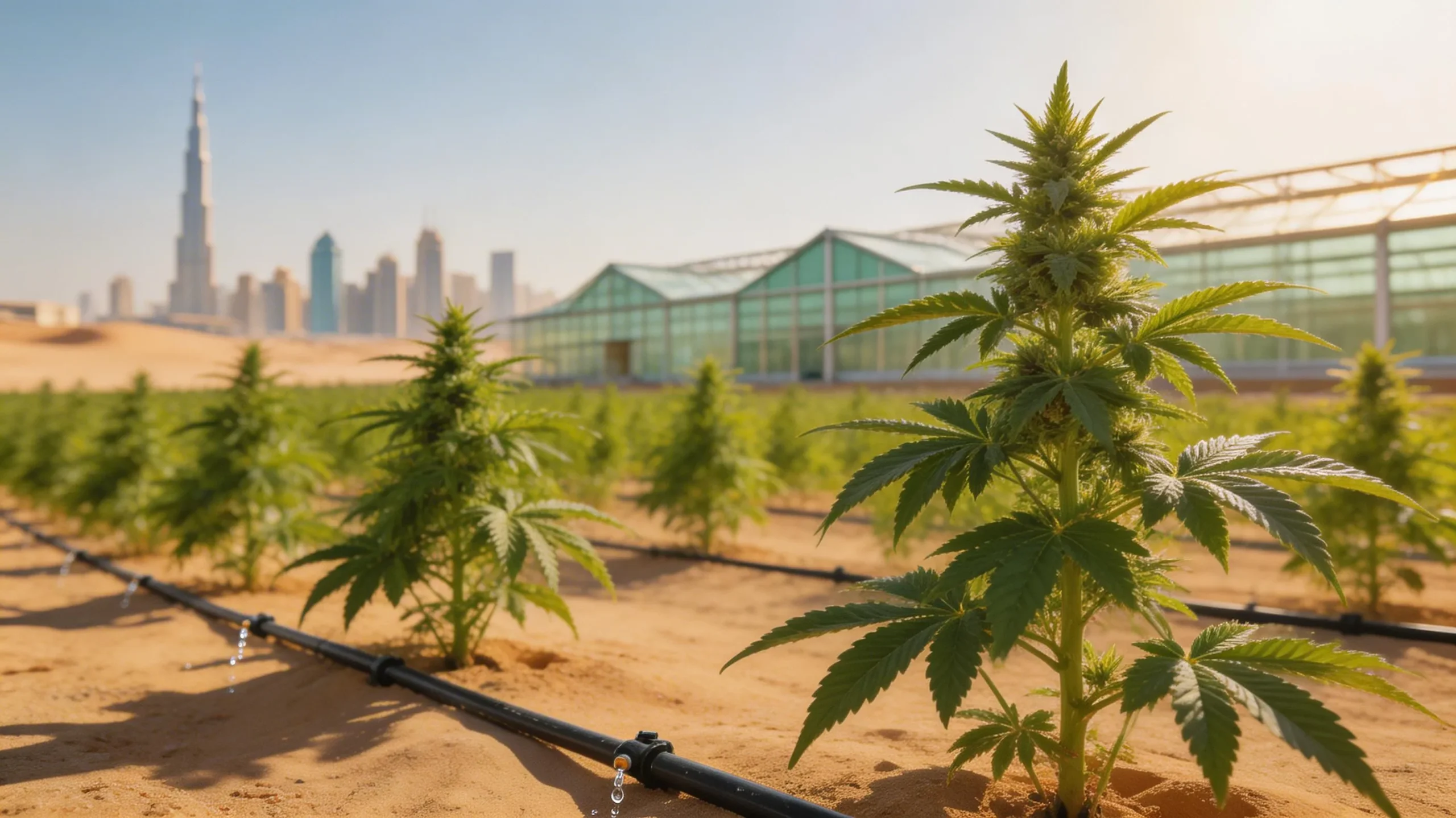
Hemp is everywhere.
From sustainable fashion brands promoting eco-friendly fabrics to wellness products positioned as natural alternatives, from nutrient-rich food items to skincare formulations, hemp has quietly but rapidly become part of a much larger global movement. It is no longer a niche ingredient or a specialized material. Today, it sits at the intersection of sustainability, health, and innovation, naturally leading many to ask, Are Hemp Products Safe to Use in the UAE?
Scroll through any online marketplace, explore international brands, or even browse ingredient labels, and you’ll likely come across something labeled “hemp.” It is often presented as clean, safe, plant-based, and forward-thinking, something that aligns perfectly with modern consumer values.
And on a global level, that perception largely holds true.
But in the UAE, the conversation shifts.
Because here, visibility does not automatically translate to permission.
So naturally, one question comes up, almost immediately, and often with a sense of caution:
“Are hemp products allowed here?”
It sounds like a simple yes-or-no question. A straightforward query that should have a clear answer.
But in reality, it’s not that simple.
Because in the UAE, the concept of “allowed” is not based on how a product is marketed or labeled. It is not determined by global popularity or widespread usage. Instead, it is defined by a much more structured set of criteria.
What does the product contain?
Does it include any cannabinoids like THC or CBD?
How is it classified: food, textile, extract, or medical product?
And most importantly, does it comply with UAE regulations?
These are the questions that actually determine whether a hemp product is allowed.
And this is where most of the confusion begins.
Globally, hemp is often treated as a non-psychoactive, safe, and widely accepted plant. It is associated with sustainability, wellness, and innovation. But in the UAE, the conversation is not driven by assumptions, it is guided by regulation, classification, and compliance.
This creates a gap between perception and reality.
A product that seems completely normal in one country may require careful evaluation in another. Something that appears harmless on the surface may still fall into a regulated category depending on its composition.
And that’s why guessing doesn’t work here.
To truly understand whether hemp products are allowed in the UAE, you need to move beyond general impressions and look at how these products are actually defined within the system.
So instead of relying on assumptions, let’s break it down properly, step by step.
Understanding Hemp in the UAE Context
Before answering whether hemp products are allowed in the UAE, it’s essential to first understand what hemp actually is, and more importantly, how it is interpreted within the UAE’s regulatory framework.
Hemp is a variety of the cannabis plant, distinguished primarily by its very low THC content, typically at or below 0.3%. At this level, it does not produce psychoactive effects, meaning it does not cause the “high” commonly associated with cannabis.
Because of this, hemp is widely used across industries.
It appears in food products like seeds and oils, in textiles and sustainable materials, in skincare formulations, and even in wellness-related applications. Globally, it is often treated as a versatile and non-intoxicating plant with a wide range of uses.
But here’s where the UAE perspective becomes different, and much more precise.
In the UAE, products are not evaluated simply based on the label “hemp.”
The word itself is not enough to determine whether something is allowed or not.
Instead, every product is assessed based on specific, measurable criteria.
The first and most important factor is THC content. Even though hemp contains very low levels of THC, its presence still matters. THC is a controlled substance, and its inclusion, even in trace amounts, can influence how a product is classified and regulated.
The second factor is the presence of cannabinoids, such as CBD or THC. Products that contain cannabinoids are treated differently from those that do not. For example, hemp fiber and seeds are very different from hemp extracts or CBD-based formulations, even though they all come from the same plant.
The third factor is the type of product. Is it a food item? A textile? A cosmetic? A wellness product? Or a medical formulation? Each category falls under different regulatory considerations, which means the same plant can lead to very different outcomes depending on how it is used.
And finally, there is regulatory approval and compliance. This is the deciding factor. A product must meet UAE import laws, safety standards, and documentation requirements. Without this, even a globally accepted product may not be considered permissible.
This structured approach leads to an important conclusion:
Two products can both be labeled as “hemp,” yet be treated completely differently under UAE law.
One may be fully acceptable, while the other may require strict regulation, or may not be permitted at all.
This is why understanding hemp in the UAE is not just about knowing what the plant is.
It is about understanding how the system evaluates it.
And once that perspective becomes clear, the broader question, whether hemp products are allowed, becomes much easier to answer.
So, Are Hemp Products Allowed in the UAE?
The most accurate answer is:
Some hemp products are allowed, but not all.
And more importantly, they are not allowed simply because they are labeled as “hemp.”
In the UAE, permission is not defined by branding, trends, or global acceptance. It is defined by what the product contains, how it is classified, and whether it complies with local regulations.
This is where most misunderstandings begin.
Globally, hemp is often seen as a safe and non-psychoactive plant, largely because of its low THC content (typically ≤ 0.3%). But in the UAE, this global definition is only one part of the picture.
Here, products are evaluated based on:
Their THC content
Whether they contain cannabinoids like CBD or THC
Their intended use (food, industrial, wellness, or medical)
And whether they meet regulatory approvals and compliance standards
This means the UAE does not follow a blanket “allowed” or “not allowed” rule for hemp.
Instead, it follows a case-by-case approach, where each product is assessed individually.
And that’s why understanding different categories of hemp products becomes essential.
1. Hemp Seeds and Food Products
Hemp seeds are among the most widely accepted hemp products globally, and they are also one of the least complex categories in the UAE.
These seeds are valued for their nutritional benefits, including high-quality protein, essential fatty acids, vitamins, and minerals. They are commonly used in food products such as protein powders, oils, and health supplements.
Most importantly, hemp seeds contain negligible to zero THC, as they come from parts of the plant that do not produce cannabinoids.
Because of this, they are not associated with psychoactive effects in any way.
In the UAE, hemp seed-based food products are generally more likely to be permitted, provided they:
Meet UAE food safety standards
Comply with import regulations
Are properly labeled and documented
This makes them one of the most straightforward and clearly accepted categories of hemp products.
2. Hemp Fiber and Industrial Products
Hemp fiber, derived from the stalk of the plant, is used in textiles, clothing, ropes, paper, and eco-friendly materials.
It is widely recognized for its durability, sustainability, and environmental benefits, making it a popular alternative in industries focused on sustainable production.
From a regulatory perspective, hemp fiber products are among the least complicated.
They contain no relevant THC or cannabinoids, meaning they are not linked to psychoactive substances at all.
As a result, these products are treated as industrial or textile goods, rather than cannabis-related substances.
In the UAE, this places hemp fiber products among the safest and most clearly permissible categories, as long as they comply with standard import and trade regulations.
3. Hemp Oils and Extracts
This is where the conversation becomes more nuanced.
Hemp-derived oils and extracts are produced from parts of the plant that may contain cannabinoids. Depending on how they are processed, these products can vary significantly in composition.
Some may contain trace amounts of THC, particularly in full-spectrum extracts. Others may be refined to remove THC entirely.
Globally, products with THC levels below 0.3% are considered non-psychoactive and are widely accepted in wellness and personal care industries.
However, in the UAE, this threshold alone does not determine whether a product is allowed.
These products must also:
Meet strict regulatory approvals
Comply with UAE import laws.
Be clearly labeled with an accurate composition.
Fall within permitted product categories.
Without meeting these requirements, even a product that is widely accepted internationally may not be allowed in the UAE.
This highlights a key principle:
In the UAE, compliance matters more than global classification.
4. CBD Products
CBD products are one of the most widely discussed, but also most misunderstood, categories in the hemp space.
CBD (cannabidiol) is a non-psychoactive compound, meaning it does not produce a “high.” Globally, it is often associated with wellness, relaxation, and general well-being.
However, in the UAE, CBD is not treated as a general consumer product.
Its presence still places it under regulatory scrutiny because it is derived from the cannabis plant.
CBD products are not freely available in retail markets, and they are not sold over the counter as lifestyle or wellness products.
Instead, CBD is typically only permitted when it is part of:
Approved pharmaceutical products
Prescribed medical treatments
Regulated healthcare use
This means that most CBD products commonly available in global markets are not automatically allowed in the UAE.
5. Medical Use and the Role of THC (Understanding the 0.3% Rule)
One of the most important aspects of this entire conversation is how medical use and THC are treated in the UAE.
Globally, the 0.3% THC rule is used to define hemp as non-psychoactive. At or below this level, products are generally considered safe for widespread use.
But in the UAE, this rule does not act as automatic permission.
Even trace amounts of THC are taken seriously because THC is classified as a controlled substance.
This means that a product is not allowed simply because it contains THC below 0.3%.
Instead, what matters is context.
The UAE has introduced a controlled pathway for medical use, where certain cannabis-derived compounds, including CBD and, in some cases, THC, may be permitted, but only under strict conditions.
These include:
Use in approved pharmaceutical formulations
Prescription by licensed medical professionals
Administration within regulated healthcare systems
Continuous monitoring and compliance
In this setting, THC is not treated as a general-use ingredient; it is treated as a controlled medical compound.
This creates a clear distinction:
THC in consumer products → restricted
THC in approved medical use → controlled and permitted
So while the 0.3% rule helps define hemp globally, in the UAE, it is only one part of a much larger regulatory framework.
What ultimately determines whether a product is allowed is not just how much THC it contains, but how, where, and why it is being used.
Understanding the Core Reality
When you step back and look at all these categories together, a very clear pattern begins to emerge, one that simplifies the entire conversation around hemp in the UAE.
At its core, the distinction is not about the word “hemp” itself, but about what comes from the plant and how it is used.
Hemp products that do not involve cannabinoids, such as hemp seeds and hemp fiber, are generally treated as straightforward and low-risk. These products exist outside the psychoactive conversation entirely. They are used for nutrition, textiles, and industrial purposes, and because they contain negligible to zero THC, they are more easily aligned with regulatory expectations.
On the other hand, hemp products that involve cannabinoids, such as oils, extracts, or formulations derived from the plant’s flowers and leaves, enter a different category altogether. These products require closer evaluation because they may contain compounds like THC or CBD, even in trace amounts.
And then there is a third layer.
Products that contain or are built around cannabis-derived compounds like CBD and THC fall into the most tightly controlled category. These are not treated as general-use or consumer products. Instead, they are only permitted within regulated medical contexts, where their use is approved, prescribed, and monitored.
This layered structure reveals an important truth:
The UAE does not regulate hemp as a single, uniform category.
It regulates components, composition, and context.
It looks at what part of the plant is being used.
It evaluates whether cannabinoids are present.
And it considers how the product is intended to be used, whether as food, material, wellness product, or medical treatment.
Once you understand this, the entire system starts to make sense.
Because what may seem like inconsistent rules at first is actually a highly structured and logical framework.
The Role of THC in Determining Legality
If there is one factor that sits at the center of this entire framework, it is THC.
THC, or tetrahydrocannabinol, is not just another compound; it is the defining element that determines how cannabis-related substances are treated legally.
Even though hemp contains very low levels of THC, typically at or below 0.3%, its presence still plays a critical role in how a product is evaluated in the UAE.
In many global markets, the 0.3% THC threshold is used as a clear dividing line. Products below this level are considered non-psychoactive and are widely accepted across industries.
But in the UAE, the situation is more nuanced.
THC is classified as a controlled substance, which means its presence is not ignored, even in small amounts. It must be carefully assessed within the broader context of the product.
This leads to three key realities:
THC is not evaluated casually; it is treated with regulatory sensitivity.
Its presence must be clearly identified, documented, and justified.
And most importantly, compliance matters more than just the percentage.
This means that legality is not determined solely by whether THC is below 0.3%.
Instead, it is determined by a combination of factors:
Has the product been approved by authorities?
Does it meet UAE import and safety regulations?
Is it categorized correctly within the system?
Is its use appropriate for its classification?
In other words, THC acts as a trigger for deeper regulatory evaluation.
It is not just about how much THC is present; it is about how that presence fits within the legal framework.
And that is what ultimately determines whether a hemp product is allowed or not.
Why There Is So Much Confusion
If the system is this structured, why does so much confusion still exist?
The answer lies in the gap between global perception and local reality.
There are several key reasons why people often misunderstand hemp regulations in the UAE.
1. Global vs Local Differences
One of the biggest sources of confusion is the difference between how hemp is treated globally and how it is regulated locally.
In many countries, hemp products, especially those with low THC, are widely available and openly marketed. This creates a perception that these products are universally acceptable.
But the UAE operates under its own regulatory framework.
A product that is freely sold in another country may still require approval, or may not be allowed at all, within the UAE. This difference is not always obvious to consumers, especially when they are exposed to global brands and online marketplaces.
2. Marketing Language
The way hemp products are marketed also contributes to confusion.
The word “hemp” is often used broadly, without clearly explaining what the product actually contains. A product labeled as “hemp-based” may or may not include cannabinoids like CBD or trace amounts of THC.
This lack of specificity can blur the lines between very different product types, making it difficult for consumers to understand how they are classified.
In reality, two products with the same label can be treated completely differently depending on their composition.
3. Lack of Awareness
Another major factor is simply the lack of accessible, clear information.
Many people are not fully aware of how UAE regulations differ from global norms. They may understand hemp in a general sense, but not how it is evaluated within a specific legal framework.
This leads to assumptions based on incomplete knowledge, where global understanding is applied to a local context without considering the differences.
4. Assumptions About “Natural” Products
There is also a common belief that if something is natural or plant-based, it is automatically safe and allowed.
But in the UAE, this is not always the case.
A product being natural does not exempt it from regulation. What matters is not just its origin, but its composition and classification.
Even plant-derived substances can fall under regulatory scrutiny if they contain compounds that are controlled or require evaluation.
What This Means for Consumers in the UAE
For consumers in the UAE, the most important takeaway is not just about what is allowed, but how to approach hemp products responsibly.
The key shift is simple, but powerful:
Do not rely on assumptions.
In a global environment where hemp is widely marketed as natural, safe, and beneficial, it is easy to assume that the same applies everywhere. But in the UAE, decisions cannot be based on general perception or global trends. They must be based on understanding and verification.
This means taking a more informed and intentional approach.
Start by understanding what the product actually is. Is it a food item made from hemp seeds? A textile product made from fiber? Or is it an extract that may contain cannabinoids? This distinction alone can change how the product is viewed within the UAE.
Next, look deeper into what the product contains. Does it include THC, CBD, or any other cannabinoids? Even trace amounts can influence how the product is classified and whether it falls within regulated categories.
And most importantly, verify whether the product complies with UAE regulations. This includes checking if it meets import requirements, safety standards, labeling norms, and whether it falls within permitted product categories.
This approach may seem more detailed than simply relying on labels, but it is necessary.
Because in the UAE, permission is not based on popularity, marketing, or global acceptance.
It is based on compliance and classification.
This also means that consumers play an active role in ensuring their own awareness. Instead of asking only “Is this allowed?”, the better question becomes:
“Do I understand this product well enough to know whether it fits within the UAE framework?”
And once that mindset is adopted, navigating hemp products becomes much clearer and more confident.
The Bigger Picture: A Controlled but Evolving Market
The UAE is not ignoring hemp, nor is it resisting its global growth.
Instead, it is approaching it with care, structure, and long-term thinking.
While the global hemp industry is expanding rapidly, driven by wellness trends, sustainability movements, and evolving consumer preferences, the UAE is taking a more measured and structured path. It is allowing the conversation to develop, but within a system that prioritizes regulation over speed, ensuring that growth remains aligned with safety, compliance, and long-term stability rather than rapid, uncontrolled expansion.
This means the market is still in a developing phase.
Awareness is increasing. Consumers are becoming more curious. Businesses are exploring possibilities. And regulatory frameworks are gradually becoming more defined.
But this growth is not happening in an open or unrestricted environment.
It is happening within a controlled system.
This system is characterized by:
No open market where all hemp products are freely available
No blanket ban that rejects all hemp-related products
But a selective, case-by-case approach that evaluates each product individually
This approach reflects a balance.
On one side, it allows for innovation, awareness, and gradual integration of hemp-based products. On the other hand, it ensures that safety, compliance, and regulatory clarity are never compromised.
It also suggests something important about the future.
As awareness improves and regulations continue to evolve, the market may expand, but it will do so in the same way it is evolving now:
Structured. Measured. Controlled.
This is not a market that will grow through rapid shifts or sudden changes. It will grow through understanding, alignment, and gradual development.
And that is what makes it unique.
Conclusion: Allowed, But Not Without Conditions
So, are hemp products allowed in the UAE?
The answer is yes, but with an important clarification:
They are allowed, but not universally, and not without conditions.
Some hemp products, such as hemp seeds and fiber-based materials, are generally more straightforward and widely accepted. They do not involve psychoactive compounds and fit more easily within regulatory frameworks.
Other products, such as hemp oils, extracts, and CBD-based formulations, require a much deeper level of evaluation. Their composition, cannabinoid content, and intended use all play a role in determining whether they are permitted.
And in some cases, particularly where cannabinoids like CBD or THC are involved, products may only be allowed within strictly controlled medical contexts, where their use is approved, prescribed by licensed professionals, and closely monitored under regulated healthcare systems.
This layered approach can seem complex at first, but it becomes clear once you understand the core principle:
In the UAE, it’s not about the label, it’s about the composition and compliance.
A product is not judged by what it is called, but by what it contains and how it fits within the system.
Once this perspective is understood, the confusion begins to fade.
The uncertainty around hemp products becomes easier to navigate.
The difference between global perception and local reality becomes clearer.
And the answer to the original question becomes much more precise.
Because in the end, the UAE does not simply allow or restrict hemp.
It defines it, carefully, clearly, and contextually.
Leave a Reply